Impeachment
Sara Duterte Impeachment Trial: What Days 19, 20 and 21 Established
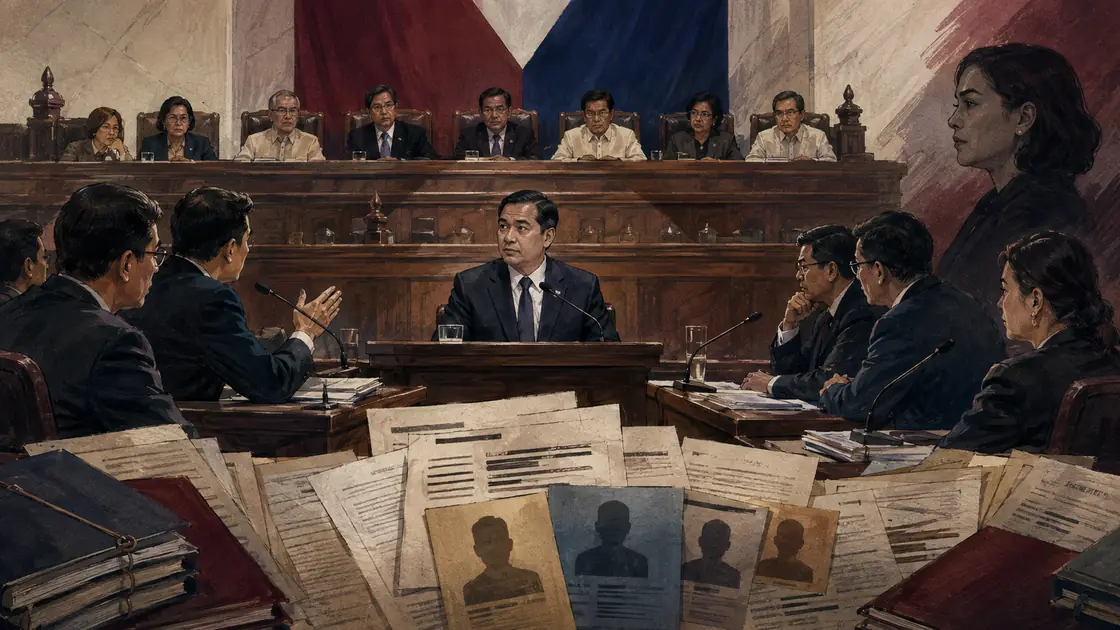
The trial tested the confidential funds case from three sides. A senior aide faced cross examination over medicines bought as rewards for informants, army officers challenged the documents used to justify Education department spending, and a member of Duterte's own defense team took the stand as a hostile witness. This recap covers Days 19 to 21, August 26, September 1, and September 2.
Key takeaways
- The week narrowed the prosecution's case, as it weighed dropping the bribery charge and trimming its witness list, while the defense saw one of its own lawyers questioned about the Education department's spending.
Frequently Asked Questions
Is the prosecution dropping any charges?
On September 2, public prosecutor Joel Chua said the House panel was considering dropping the bribery charge under Article III to focus on its strongest allegations, the same approach prosecutors took in the 2012 trial of Chief Justice Renato Corona. Prosecution adviser Robert Ace Barbers separately said the panel planned to reduce the number of witnesses on Article I, the confidential funds charge. Neither step was final as of that sitting day.
Day 19: The 'Missing Link' and the Argument Over Aliases
The court reconvened on Wednesday, August 26, with the defense cross examining Lemuel Ortonio. Under questioning by Senator judge Vicente Sotto III, Ortonio said Colonel Raymund Lachica was designated to the office through an armed forces order that made him a group commander, not hired as a regular employee, and had no employment status at the office. Presiding officer Francis Escudero opened the day with a reminder about the court's sub judice rule, which bars the lawyers from discussing the merits of the case in public, and set out the penalties under the court's rules, a public reprimand for a first breach and a fine of up to 30,000 pesos for later ones.
Senator judge Erwin Tulfo again urged both sides to present Lachica, calling him the missing link in the testimony so far, and Escudero noted that the court itself could call him if neither side did. Senator judge Raffy Tulfo pressed Ortonio on roughly 122 million pesos in confidential funds used to buy medicines as rewards for informants. Ortonio said he had not asked how the medicines were bought and had trusted the security officer, an answer Tulfo said defied logic for a man who signed the liquidation papers.
The day's liveliest exchange was about names. Senator judge Robin Padilla defended the use of aliases in confidential work, reminding a prosecutor that heroes and revolutionaries used cover names such as Dimasalang, Siling Labuyo, Tikbalang, Magdalo, and Lakambini, and that Ninoy Aquino traveled under the name Marcial Bonifacio. Senator judge Bam Aquino confirmed his uncle used that name but noted he had no confidential funds and appeared on no acknowledgment receipts.
Day 20: Army Officers Question the Paperwork
The trial resumed on Tuesday, September 1, and turned to the Education department's spending. The prosecution presented two Philippine Army officers to explain how military certifications were obtained and used by the department under Duterte to support its confidential fund liquidations.
Colonel Magtanggol Panopio testified that a certification he had issued for a youth summit was not a valid document to support liquidation before the Commission on Audit. He said he was surprised to learn the department had used it to justify its expenses, and told Senator judge Joel Villanueva that he personally believed the use of the document was improper. The testimony went to the heart of Article I, the claim that the department's confidential funds were spent without the documents the rules require.
Day 21: A Defense Lawyer Takes the Stand
On Wednesday, September 2, the prosecution called Michael Poa, who serves on Duterte's defense team and had been the department's chief of staff, and later its finance undersecretary, while she was Education secretary. Poa stepped out of his role as defense spokesperson to testify, and the court declared him a hostile witness, which let the prosecution ask leading questions. He was called to explain the department's handling of 112.5 million pesos in confidential funds during Duterte's time as secretary.
Poa testified that he signed the department's official reply to a Commission on Audit inquiry into the funds, but said he only learned that confidential money was handed to security officials during a House hearing in October 2024, not while he was inside the department. He acknowledged that he could face liability if Duterte is found guilty, while maintaining he had no personal knowledge of how the money was spent. Senator judge Imee Marcos asked him who called the meeting where office and department officials asked auditors to issue an audit query instead of a formal audit memorandum.
The examination was heated. Prosecutor Benjamin Tolosa Jr. opened by asking Poa whether he was a competent lawyer and called him an "abogadong walang alam," a lawyer who knows nothing, a remark the court struck from the record before scolding him for wasting time. Off the substance, the prosecution signaled it was narrowing the case, weighing whether to drop the bribery charge under Article III and to cut the number of witnesses on the confidential funds charge.
What Went Viral, and the Arguments Splitting Your Feed
The alias debate was the week's most shared moment. Padilla's roll call of hero cover names, set against the odd names on the confidential fund receipts, was clipped by both camps, one side reading it as a fair defense of secrecy in intelligence work, the other as an insult to the heroes whose names were being borrowed to explain missing money. Bam Aquino's reply, that his uncle used an alias but had no confidential funds, traveled just as widely.
The sight of a defense lawyer on the stand as a hostile witness gave the other side its clip. Poa's admission that he could face liability, and the abogadong walang alam jab thrown at him, spread quickly, one as a crack in the defense, the other as proof the prosecution was playing to the gallery. The plan to drop the bribery charge drew its own split, framed by Duterte's side as a case falling apart and by the prosecution as focusing on its strongest ground, the same move used in the Corona trial.
The steadier read is that a narrower case is not a weaker one by default. Dropping a charge can mean the evidence was thin, or it can mean the prosecution is concentrating its fire. Which it is here will show in whether the confidential funds testimony holds, not in the captions traded over a single day.
What the Week Settled and What It Did Not
The week added detail and subtracted scope. The court heard that a senior aide signed liquidation papers without knowing how the money was spent, that an army officer considered his own certification invalid for the purpose it was used, and that a lawyer on the defense team had signed the department's reply to auditors. At the same time, the prosecution moved to drop the bribery charge and thin its witness list.
What remains unsettled is the same question that has run through the whole confidential funds phase, where the money went and whether the gaps prove misuse or poor record keeping. The officer named as the recipient of the cash still had not testified. Conviction on any surviving article still needs at least 16 of the 24 senator judges, and the court signaled it would adjust its calendar to make room for work on the 2027 national budget.
Why Mindanao Is Watching
The week kept the case close to Duterte's circle, with a member of her own defense team and her former department staff on the stand, several of them tied to the Davao network she built. A case that now leans on her appointees explaining her office's spending is harder to frame as an attack from outside than the earlier fights over a video were.
The test in Davao and across Mindanao is whether the narrowing case reads as discipline or as weakness. A prosecution that focuses and still proves its point will land as due process. One that drops charges and loses witnesses without closing the gaps will feed the argument, already loud in the region, that the trial was political from the start. This article covers only Days 19 to 21, from August 26 to September 2.