Longform political feature
Mindanao Divided: How Mindanao Lawmakers Voted on Sara Duterte’s First Impeachment
May 26, 2026 · Joshua S Bariñan
The May 2026 Sara Duterte first impeachment vote showed Mindanao was not moving as one bloc. This province by province guide explains who voted yes, who resisted, and why local interests broke the old "Solid South" story.
Key Takeaways
- The vote weakened the simple “Solid South” reading of Mindanao politics.
When the numbers stopped matching the myth
For a long time, the Duterte name felt bigger than party lines in Mindanao. Rodrigo Duterte's rise to the presidency gave many supporters the sense that Davao had broken through a wall that used to belong only to Manila politicians.
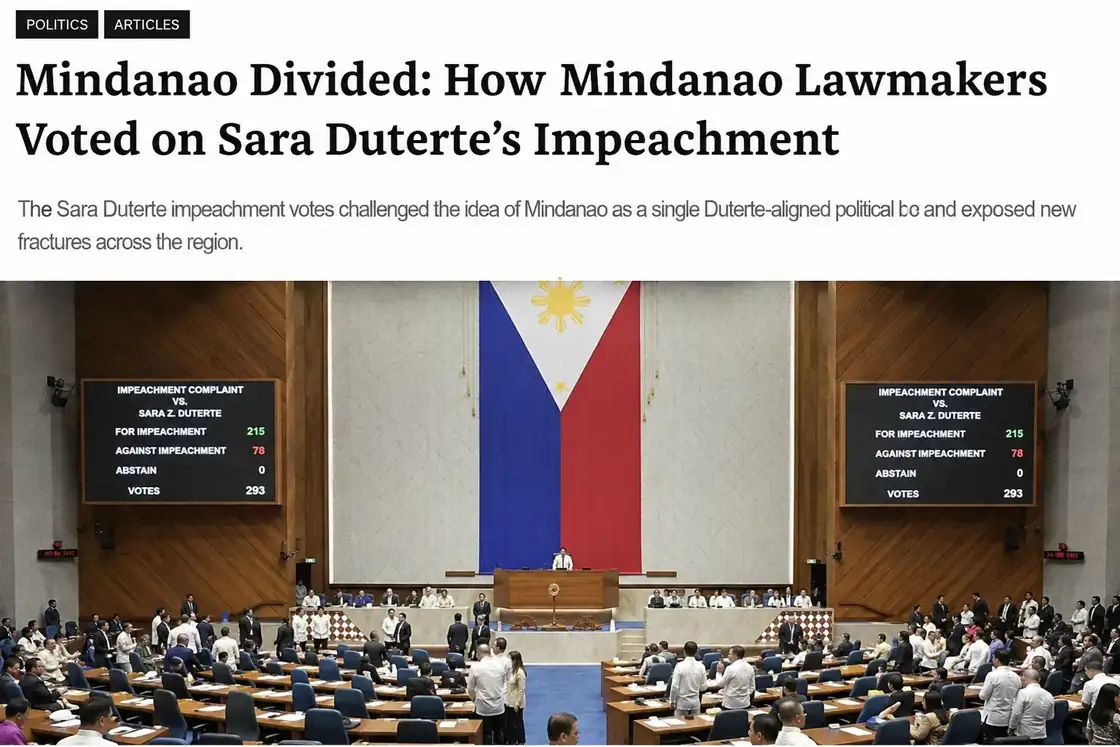
That is what makes the impeachment numbers so revealing. In February 2025, 41 of 61 Mindanao district representatives signed the first complaint. By the May 11, 2026 vote, MindaNews counted 60 Mindanao lawmakers who either voted or sat out: 41 voted yes, eight voted no, four abstained, and seven did not participate. One more Mindanao lawmaker was presiding officer. That is not a united island vote. It is a map of different local calculations.
Davao stayed loyal. Much of Mindanao did not.
Davao City did what many people expected. Paolo Duterte, Omar Duterte, and Isidro Ungab all voted no. They were in the chamber earlier but left before the roll call. The city remained firmly in Sara Duterte's corner.
Outside Davao, the pattern changed fast. Nineteen of Mindanao's 28 provinces had all of their representatives voting yes. That is why the old "Solid South" line feels harder to defend now. What surfaced instead was a more familiar kind of Philippine politics: alliances, access to power, party pressure, and early positioning for 2028.
What this split really tells us
People read the vote in very different ways. Some called it betrayal. Others said it was constitutional duty. Some saw another round of Manila versus Mindanao. All of those reactions capture part of the mood, but none of them explains the whole thing.
A better question is why neighboring lawmakers, from the same island and sometimes from the same political orbit, ended up on different sides. That answer is less dramatic but more useful. It usually comes down to local survival, access to budgets, party discipline, and each politician trying to protect their place in the next national fight.
Frequently Asked Questions
Does a yes vote automatically mean anti Mindanao?
No. The article treats each vote as a district level political choice rather than a simple label of pro or anti Mindanao.
Reader response
- Views
- 7
- Shares
- 0
- Rating
- Not rated
- Comments
- 0