Impeachment
Sara Duterte Impeachment Trial: What Days 13, 14 and 15 Established
The trial's confidential funds phase deepened as a second state auditor walked the court through disallowed spending at the Office of the Vice President and the Department of Education, and the Supreme Court cleared the last legal challenge to the case. This recap covers Days 13 to 15, August 5, 11, and 12.
Key takeaways
- Three sitting days left the prosecution with a more detailed audit record, but not yet a judicial finding that the questioned expenses amounted to an impeachable offense.
Frequently Asked Questions
Why did the trial skip Monday, August 10?
Heavy monsoon rain disrupted Metro Manila and prevented the court from sitting. Because the next hearing went ahead on August 11, this installment spans two calendar weeks rather than three consecutive dates.
Day 13: The Supreme Court Clears the Path
The court reconvened on Wednesday, August 5, but the day's biggest development came from another building. The Supreme Court dismissed the consolidated petitions that Vice President Sara Duterte and a group of lawyers led by Israelito Torreon had filed against the House impeachment proceedings. The justices called the petitions moot, reasoning that the House had already approved and transmitted the articles to the Senate, so any ruling on the House justice committee's actions would no longer change the case now before the impeachment court. House prosecutors welcomed it and said it ended the defense claim that the House inquiry was a mini trial or a fishing expedition.
Inside the chamber, the trial stayed on Article I and the alleged misuse of confidential funds. Former Commission on Audit auditor Roderick Wamil returned to face clarificatory questions from the senator judges. He testified that in his decade at the audit office, Duterte was the only vice president and the only Education secretary he had seen receive confidential fund allocations, and that the Office of the Vice President was the first agency he had encountered that refused to receive an Audit Observation Memorandum.
A conflict question also surfaced. Wamil said defense counsel Michael Poa had attended a 2023 meeting with audit officials about the liquidation of the Education department's confidential funds while Poa was serving under the Office of the Vice President. Senator judge Raffy Tulfo asked whether that created a conflict in Poa's current role. Presiding officer Francis Escudero ruled it did not, explaining that the respondent in the case is Duterte, not her lawyer.
The court also denied a defense objection and allowed the prosecution to mark part of an affidavit by Arturo Lascanas, a self described former member of the Davao Death Squad. The panel then signaled its next witness, a second audit official who would walk the court through what the commission did after it flagged the confidential funds.
Day 14: A New Auditor and the Names on the List
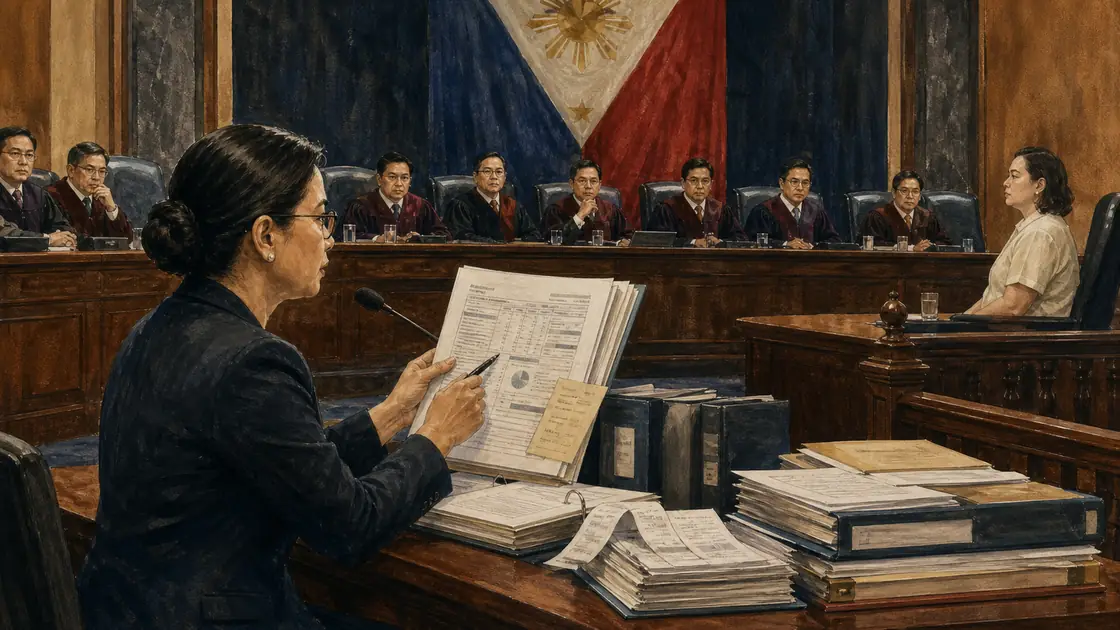
The court did not sit on Monday, August 10, as heavy monsoon rains hit Metro Manila, and it resumed on Tuesday, August 11. The prosecution called Xylene Mae del Campo, a supervising auditor from the commission's Intelligence and Confidential Funds Audit Office, with private prosecutor Lorna Kapunan leading the questioning. Del Campo walked the court through the audit findings on the Office of the Vice President and the Department of Education.
On the 2022 funds, she said the commission affirmed a notice of disallowance covering 73 million pesos of the 125 million pesos released, holding Duterte and two other officials responsible. The spending lacked proof of payment and proof that supplies were bought for intelligence work, and it included reimbursements for December 13 to 18 activities such as Christmas parties, tree planting, and a thanksgiving event that took place before the office even received the 125 million pesos on December 21.
On the 2023 funds, she said the commission disallowed the entire 375 million pesos. Special disbursing officer Gina Acosta had transferred her duty to Colonel Raymund Lachica of the vice presidential security group, which Del Campo said the 2015 joint circular forbids, because an accountable officer cannot pass the funds to another person. Some money went to individuals listed as Miggy Mango, Jay Kamote, and Matthew Keso, without the required documents. The disallowance also noted that the surveillance reports did not specify any accomplishment that showed the operations succeeded.
The Education department's 75 million pesos drew a different picture. Prosecutors said the money was disbursed in three batches covering Luzon, Visayas, and Mindanao on the same day, a schedule they called physically impossible, joking that it would make the department's disbursing officer, Eduard Fajarda, into Superman. Fajarda had earlier admitted passing his disbursing duty to Colonel Dennis Nolasco. Even so, Del Campo testified that the department's early 2023 spending was in order so far, with the caveat that a clearance can still be revoked within three years if new evidence appears.
Day 15: Cross Examination and the 'Funny Names'
Del Campo returned on Wednesday, August 12, for cross examination by defense counsel Kristine Ferrer, her third appearance on the stand. Ferrer pressed her on the unusual names attached to the 375 million pesos in confidential funds and asked whether a name that sounds funny means the recipient is fictitious. Del Campo declined to draw that conclusion and answered, "Hindi ko po siya masasagot," meaning she could not answer that.
She held her ground on the core finding. Del Campo said the office's 2023 confidential fund spending was irregular and that the identity of a supplier and the purpose of a purchase are not themselves secret. Receipts and invoices should have backed the purchases, she said, and treating every detail as confidential is not the same as protecting an actual intelligence operation. She added that confidential operations fall outside the mandate of both the Office of the Vice President and the Education secretary.
The exchanges grew sharp enough that Escudero stepped in. He asked Kapunan and Ferrer to temper their words and said the apparent generational gap between the two lawyers should not add heat to the proceedings.
What Went Viral, and the Arguments Splitting Your Feed
The names carried the week online. Miggy Mango, Jay Kamote, and Matthew Keso spread across feeds within hours, the latest in a run of odd entries on the confidential fund receipts after Andy Lim and Alejandro Pikit drew attention the week before. Pro Duterte and anti Duterte pages clipped the same list to opposite ends, one as proof of ghost recipients, the other as names the auditor herself would not call fake.
The Supreme Court ruling gave the prosecution's supporters their headline, shared as the last legal door closing on the defense. Del Campo's line that a funny name does not prove a fake recipient traveled just as far, quoted by Duterte's backers as an auditor refusing to overreach. Escudero's request that the two lawyers cool down became its own clip, framed less as law than as courtroom theater.
The steadier read is narrower than either caption. A disallowed expense means auditors rejected the paperwork, not that a court has found theft, and an odd name on a receipt raises a question it does not answer. What the money bought, and whether the gaps mean misuse or sloppy records, is still the trial's job to decide.
What the Money Phase Added and What It Did Not
The second audit witness sharpened the paper case. The court now has testimony that the commission disallowed 73 million pesos of the 2022 funds and the full 375 million pesos of the 2023 funds at the Office of the Vice President, and that the money moved through an officer who was not supposed to hold it. It also has a cleaner picture for the Education department, where the auditor found the early 2023 spending in order for now.
What the week did not do is show where the disallowed money went, which remains the harder question. A notice of disallowance can be appealed, and the defense says it will contest the 375 million peso finding. As with the threats charge, conviction on the confidential funds article would still need at least 16 of the 24 senator judges.
Why Mindanao Is Watching
Part of the money in question moved while Duterte led the Education department, but the case still circles back to Davao, where her family holds the ground. A charge built on audit notices, receipts, and joint circular rules is harder to wave off as pure persecution than a disputed video was, and that raises the stakes for how the region reads each new finding.
The test in Davao and across Mindanao is whether the audit case reads as accounting or as a hunt. Testimony that stays with the documents will land as due process. Names played for laughs and lines struck from the record, on either side, will feed the divide already visible in the region. This article covers only Days 13 to 15, from August 5 to August 12.