ICC case watch
Can FPRRD Go Home to Davao? What the ICC Timeline Really Says
May 31, 2026 · Joshua S Bariñan
Former president Rodrigo Duterte can still be acquitted in law, but the confirmed ICC charges, repeated detention rulings, and a November 30, 2026 trial date make any near term return to Davao City highly unlikely.
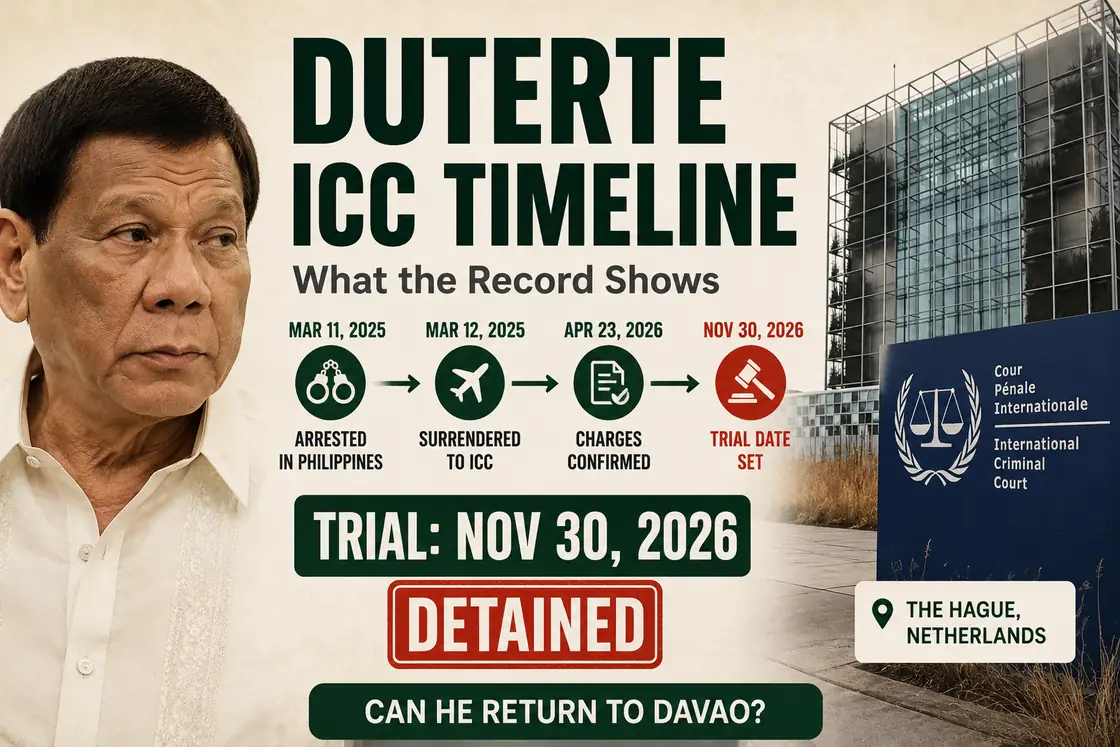
Start with the part Facebook keeps getting wrong
Every few weeks, a post claims Rodrigo Duterte has been released, that the ICC case has collapsed, or that he is already on his way back to Davao City. As of May 31, 2026, that is not what the court record says.
Rodrigo Duterte was arrested in the Philippines on March 11, 2025 and surrendered to the International Criminal Court on March 12, 2025. The ICC says the arrest warrant was issued under seal on March 7 and made public on March 11. His initial appearance took place on March 14, 2025.
The case is no longer waiting at the first doorway. On April 23, 2026, ICC Pre Trial Chamber I unanimously confirmed all charges against Duterte and committed him to trial. On May 27, 2026, Trial Chamber III set November 30, 2026 as the opening date of the trial.
What the charges actually cover
The confirmed charges are crimes against humanity, specifically murder and attempted murder under the Rome Statute. The ICC confirmation decision says the alleged crimes were committed in the Philippines between November 1, 2011 and March 16, 2019 in the context of the so called war on drugs.
That date range matters for Davao City. It covers part of former President Rodrigo Duterte's final years as Davao City mayor, his 2016 presidential campaign transition, and the early years of his presidency. The ICC materials describe the prosecution theory as covering alleged killings tied to the Davao Death Squad period and the national drug war.
None of this is a conviction. Confirmation of charges means the Pre Trial Chamber found substantial grounds to believe the case should proceed to trial. Duterte remains presumed innocent unless and until the Trial Chamber finds otherwise.
Why a quick return is unlikely
The clearest reason is procedural. The court has already moved the case into the trial phase, and the trial is scheduled to begin on November 30, 2026. ICC trials usually move slowly because witness evidence, victim participation, translation, disclosure, health issues, and appeals can stretch the calendar.
Duterte's defense has repeatedly tried to change the path of the case. The September 2025 interim release request was rejected, and the Appeals Chamber confirmed that rejection on November 28, 2025. A detention review was also upheld on appeal on March 6, 2026.
The defense also challenged the ICC's jurisdiction. The Pre Trial Chamber rejected that challenge on October 23, 2025, and the Appeals Chamber confirmed the ruling on April 22, 2026. The court's position is that it may exercise jurisdiction over alleged crimes committed while the Philippines was still covered by the Rome Statute, before withdrawal took effect in March 2019.
Health arguments have not stopped the case
Duterte is 81 years old. His lawyers argued that health and cognitive concerns justified delaying the proceedings. The court ordered a medical assessment and, on January 26, 2026, found him fit to take part in the pre trial proceedings.
That finding did not end every possible health issue forever. Trial Chamber III can still manage future fitness questions if new medical facts arise. But as of the latest verified record, health arguments have not produced release or indefinite adjournment.
This is why the realistic answer is different from the emotional answer. Many supporters in Davao City want him home, and many critics want the trial to move quickly. The court is moving by its own legal calendar, not by either side's social media clock.
What would have to happen for him to come home
There are only a few realistic legal routes. He could be acquitted after trial. The case could change because of a successful future motion. The court could order release under a detention or health ruling. Or some unforeseen procedural development could alter the situation.
But none of those is the present status. The present status is confirmed charges, continued detention, and a trial date. Even a best case scenario for Duterte inside the courtroom would likely take time, because a full trial and any appeals would not finish overnight.
At home, Davao City politics has not frozen in place. Sebastian Duterte is now mayor after the oath issue, while Sara Duterte's national battles keep the family at the center of Davao Region politics.
So can FPRRD go home to Davao City? Technically, yes, if the law later produces a release or acquittal. Is he likely to come home soon? Based on the verified ICC timeline as of May 31, 2026, no. The near term calendar points to The Hague, not Davao City.
Reader response
- Views
- 20
- Shares
- 1
- Rating
- Not rated
- Comments
- 0