Bangsamoro Autonomous Region in Muslim Mindanao / Cotabato City / Cotabato City
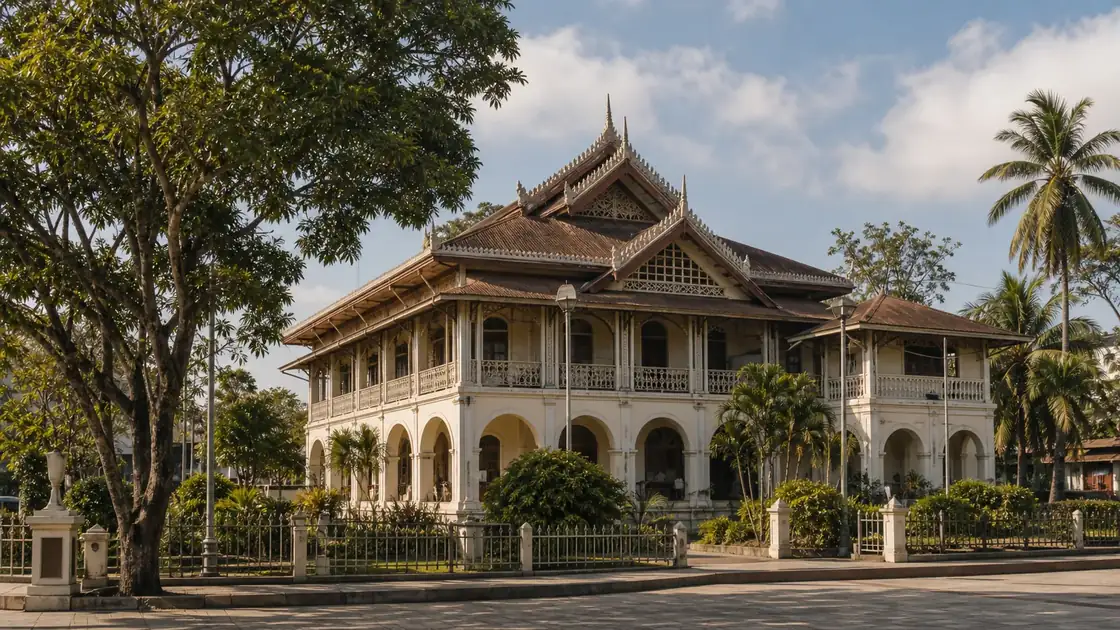
Old Cotabato City Hall
Edited by Joshua S Bariñan
Best for
- Civic heritage
- Cotabato City
Map address
Place guide
Updated June 2026
On the Ground
The building stands on A. Dorotheo Street in Cotabato City's civic center, close enough to Tantawan Park that the park appears first on the Quezon Avenue approach. Tantawan Park sits at the foot of Pedro Colina Hill and marks the traditional arrival point of Shariff Kabunsuan, the Maguindanao Islamic missionary credited with introducing Islam to the Pulangi River valley in the 15th century.
Pedro Colina Hill was painted in 2018 under a Department of Tourism Region 12 program, with barangay houses along its slope rendered in rainbow tones by the Selected Local Artists of Cotabato City, depicting crabs, kulintang gongs, and guinakit, the traditional Moro river vessel. The restoration of the old hall building to its 1940s appearance is being managed by heritage architects Gerard Lico and Marlo Basco, with work scheduled to begin in 2026.
Plans assign civic artifacts and exhibits to the ground floor while the second floor will absorb the former city library collection. KCC Mall of Cotabato, at the Quezon Avenue and Sinsuat Avenue corner, is the nearest large commercial reference point and reachable in roughly five minutes by tricycle from A. Dorotheo Street.
The outside of the building is famous for its detailed murals that tell the story of the city from the arrival of Islam to the present day. Even if the museum inside is closed for repairs, the artwork on the outside is a complete history lesson by itself.
Standing on Pedro Colina Hill gives you a clear look at how the city is built around the Rio Grande de Mindanao. It is the highest point in the downtown area and the best place to understand the geography of the Bangsamoro capital from above.
Because the building sits inside a police and military area on PC Hill, you will pass through a checkpoint. It is generally open to visitors during the day, but carry an ID and be ready to tell the guards you are there for the view and the heritage site.
The structure was designed by Juan Arellano, the same architect who did the Manila Metropolitan Theater. It has a neo vernacular style that feels more grounded and historic than the newer government buildings at the People's Palace.
The Murals and the PC Hill View
The biggest reason to visit the Old City Hall is for the artwork on the outside. The building is covered in massive murals that act as a visual timeline of Cotabato City. It starts with the arrival of Islam and the sultanates and goes all the way to the modern day. Even if you cannot get inside the building, the exterior is a complete history lesson. Since it is located on Pedro Colina Hill (PC Hill), you also get a panoramic view of the Rio Grande de Mindanao and the city skyline. It is the best spot to see how the city is geographically tied to the river.
Practicalities of Visiting PC Hill
Because the Old City Hall sits inside a police and military reservation, there is a checkpoint at the bottom of the hill. It is generally open to visitors during the day. Just bring a valid ID and tell the guards you are there to see the heritage site and the view. If you want to see the interior museum exhibits, it is a good idea to visit the 'People's Palace' (the new city hall) first to ask the tourism office if they can help you coordinate access. Late afternoon is the best time for photos when the light hits the murals directly.