Policy analysis
What Would Mindanao Separation Require? A Policy Analysis
June 21, 2026 · Joshua S Bariñan
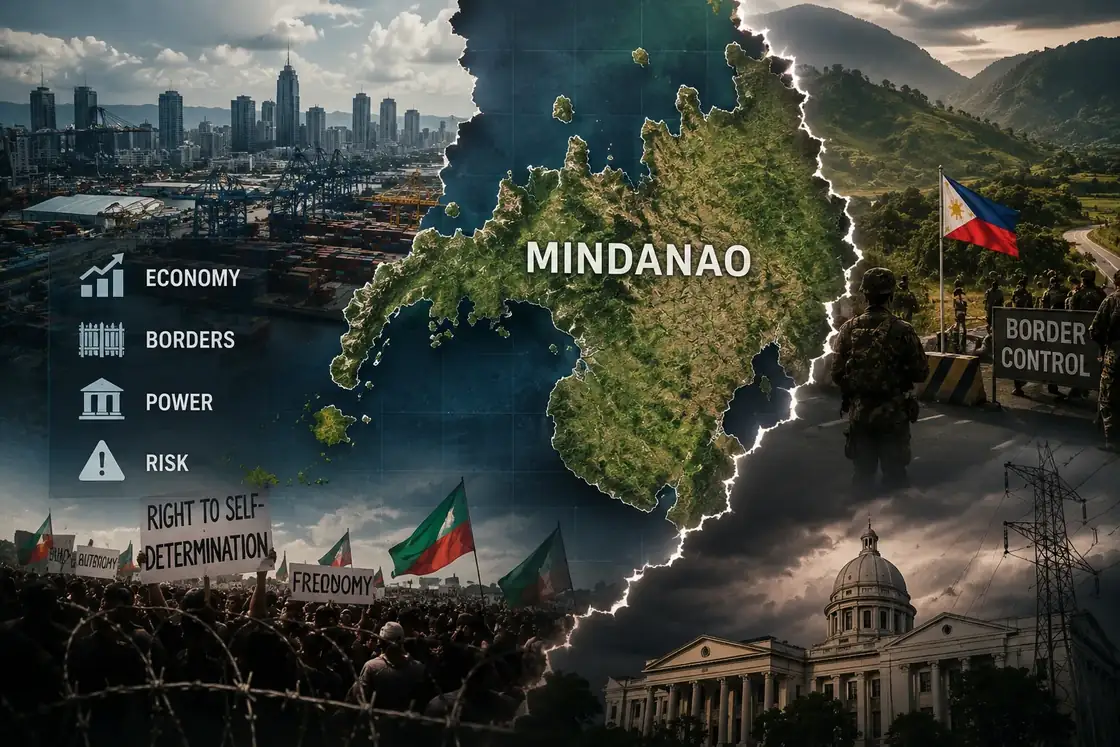
This analysis looks at what Mindanao separation would require beyond political speeches: constitutional changes with no existing legal pathway, a BARMM governance problem that cannot be assumed away, fiscal transition costs, trade reclassification, security institution building, citizenship questions, and what supporters and critics say. It does not advocate a position on either side.
Key Takeaways
- Fiscal transition, debt apportionment, trade reclassification, and security institution building are the core practical work of what independence actually means.
What this analysis covers
Mindanao separation is a recurring political topic in the Philippines. Politicians raise it during charter change debates, when the Marcos Duterte alliance collapsed in 2024, and whenever Mindanao representatives argue that national decisions are being made without adequate regional input.
This analysis does not advocate for or against separation. It examines what a real separation process would require: constitutional changes, governance design, fiscal transitions, trade arrangements, citizenship, infrastructure, and security. The goal is to make the complexity of the question visible, not to resolve it.
Historical context: where the argument comes from
Mindanao has been part of the Philippine state since 1946, but the relationship with the national government has been uneven. Large scale government sponsored resettlement of migrants from Luzon and the Visayas, beginning in the 1950s, changed the island's demographic makeup and displaced many Lumad and Bangsamoro communities from ancestral lands.
Armed conflict between the government and Bangsamoro groups, running from the late 1960s through multiple ceasefire and peace agreement cycles, produced the Autonomous Region in Muslim Mindanao in 1989 and later BARMM under the Bangsamoro Organic Law ratified in 2019. The National Democratic Front also maintained an armed presence in parts of Mindanao throughout this period.
Federalism was a major campaign theme for Rodrigo Duterte in 2016, with the argument that stronger regional autonomy would address long standing grievances. Federalism proposals were debated across his term without being ratified. Outright separation talk became louder in 2024 after the public collapse of the alliance between the Marcos and Duterte political families.
Constitutional questions
The 1987 Philippine Constitution establishes the Philippines as one indivisible nation. It does not provide a mechanism for regional secession. A legal Mindanao separation would require either a constitutional convention to write a new constitution or a constituent assembly to amend the existing one. Either path requires a three fourths vote in both chambers of Congress, which Mindanao delegations alone cannot produce.
After any constitutional revision, the new or amended constitution would need ratification in a national plebiscite. Voters across all Philippine regions would vote on it, not just Mindanao. The outcome would depend on support or opposition from Luzon and Visayas voters, who together make up the majority of the national electorate.
International recognition is a separate legal process. Even if a constitutional change allowed separation, a new Mindanao state would need to apply for United Nations membership and negotiate bilateral recognition agreements with other countries. This process can take years and is not guaranteed.
Governance implications
Mindanao today is administered across six distinct regions: Davao Region, Northern Mindanao, SOCCSKSARGEN, Caraga, Zamboanga Peninsula, and BARMM. These regions have different economic profiles, ethnic compositions, historical relationships with the central government, and political leadership.
A new Mindanao state would need to create national level institutions that do not currently exist: a central government, a legislature, a judicial system, executive agencies, a civil service, currency or monetary arrangements, and a defense establishment. The existing regional administrative structures are arms of the Philippine national government, not sovereign entities.
Who would lead the new government, how representation between the six regions would be apportioned, and how BARMM's existing autonomous parliament would relate to the new national structure are constitutional design questions that would need to be settled before independence, not after.
BARMM: the most complicated part
The Bangsamoro Autonomous Region in Muslim Mindanao has its own Parliament, executive government, and institutions created under the Bangsamoro Organic Law ratified in 2019. This is the result of a separate decades long peace process between the national government and the Moro Islamic Liberation Front.
BARMM's legal framework was designed to operate within a Philippine state, not as part of an independent Mindanao. Any separation scenario would require deciding whether BARMM joins the new Mindanao state, seeks its own independence, or negotiates a special status between Manila and the new Mindanao government. None of those outcomes can be assumed.
A new Mindanao government that tried to absorb or override BARMM's autonomous framework without agreement would likely face the same political conflict that drove the original peace process. The tendency in separation debates to treat BARMM as a detail rather than a separate governance question is one of the clearest analytical gaps in how the topic is usually discussed publicly.
Fiscal and budget questions
Local governments in Mindanao receive intergovernmental transfers from the national government through the National Tax Allotment. This is a significant portion of the operating budgets for many provinces and cities. A separate Mindanao state would need to replace those transfers with its own tax collection and revenue system.
Under international law, successor states or separating territories typically negotiate a share of the predecessor state's national debt. A Mindanao share of Philippine national debt, calculated by population or economic contribution, would be a substantial financial obligation from the first day of independence.
Establishing a new tax authority, banking system, currency or currency peg arrangement, and fiscal management institutions would take time. The transition period before those systems were functional would be one of significant fiscal stress for public services, salaries, and infrastructure maintenance.
Trade and economic implications
Mindanao's economy is tied to interisland trade with Luzon and the Visayas. Agricultural exports from Mindanao, including bananas, pineapples, corn, tuna, coconut, and livestock, move through domestic supply chains. Separation would reclassify those shipments as international exports, adding tariffs, customs requirements, and regulatory procedures.
International trade agreements that the Philippines holds with other countries would not automatically extend to a new Mindanao state. The new state would need to negotiate accession to those agreements, which could take years. Exporters who relied on Philippine trade arrangements would face uncertainty during that period.
Mindanao's major ports, including Davao, General Santos, Cagayan de Oro, Zamboanga, and Surigao, would shift from domestic to international ports. Customs infrastructure, port operations, and maritime security management would all require investment and redesign.
Infrastructure and public services
National agencies currently operate major infrastructure in Mindanao. DPWH manages roads and bridges. DOH operates regional hospitals. DepEd funds schools. DICT sets telecommunications policy. NPC manages power generation. NIA oversees irrigation systems. A new Mindanao state would need to take over those functions or negotiate transition arrangements with the Philippine government.
The Mindanao power grid connects to the rest of the Philippine national grid. National infrastructure projects currently in progress in Mindanao, including the Mindanao rail corridor and federally funded roads and facilities, would need a negotiated settlement on ownership, debt, and operations.
State universities and colleges operating in Mindanao are funded through the national budget. Whether those institutions would be transferred to the new state's authority, and at what cost, would be part of the broader institutional settlement that would need to precede any transition.
Security and military questions
The Armed Forces of the Philippines and the Philippine National Police operate across Mindanao. A separating state would need to either build its own defense and police forces from the beginning or negotiate a transition in which some AFP and PNP personnel transferred to the new state's service.
Philippine maritime baselines under UNCLOS cover the waters around Mindanao. Renegotiating those baselines in an independence scenario would require international legal proceedings, and the outcome of any maritime boundary dispute would be uncertain.
Active armed groups in Mindanao, including remaining BIFF factions and NPA units, would not automatically accept the authority of a new Mindanao government. Security normalization, which the national government has been working on for decades, would restart under a new institutional arrangement.
Citizenship and borders
Filipino citizens in Mindanao would face a citizenship decision under any separation scenario: remain Philippine citizens, accept Mindanao citizenship, or hold dual citizenship if the two states negotiated an arrangement for it. The terms would depend on what was agreed during separation negotiations.
Mindanaoans currently living and working in Luzon, the Visayas, or abroad on Philippine passports would face uncertainty about which nationality their documentation represented and what rights they would retain under each state.
Labor movement across the Philippine islands is currently unrestricted. A border between Mindanao and the rest of the Philippines would affect the movement of workers. OFW arrangements, Social Security System coverage, employment contracts referencing Philippine law, and remittance flows would all require renegotiation or transitional arrangements.
What supporters of the idea say
Advocates for greater Mindanao autonomy or independence typically argue that the island generates significant agricultural and resource wealth but receives less per capita public investment than Luzon. They point to infrastructure deficits, higher poverty rates in several Mindanao provinces compared with Metro Manila, and the decades long conflict in parts of the island as evidence that the current governance relationship has not worked for Mindanao.
Supporters also argue that Mindanao's cultural and historical distinctiveness, including its Indigenous communities, its Bangsamoro population, and the regional identities that developed through settlement history, makes it a candidate for a different political arrangement than the current unitary state provides.
Some advocates distinguish between outright independence, a federal arrangement that gives Mindanao much greater fiscal and legislative autonomy within the Philippines, and expanded BARMM style autonomy for additional parts of the island. These positions have different legal requirements and different practical implications and are sometimes conflated in public debate.
What critics say
Critics argue that separation would impose substantial short term costs on ordinary Mindanaoans: fiscal stress from replacing national transfers, trade disruption from reclassifying domestic commerce as international exports, and security risk during the period of building new institutions. They question whether the institutional foundation for an independent state currently exists.
Critics also note that Mindanao is not politically unified. The six administrative regions have different interests, and BARMM, which already has its own autonomous institutions, would not automatically want to become part of a new Mindanao state. A project built on the assumption that Mindanao speaks with one political voice ignores the island's internal diversity.
Some critics of the framing argue that when separation rhetoric gets loudest in Philippine politics, it tends to coincide with national political crises rather than sustained civic demand from Mindanao communities. They read the most prominent advocacy as a political tool during specific conflicts rather than a fully developed governance proposal.
Frequently Asked Questions
Could Mindanao survive economically on its own?
Mindanao produces a significant share of Philippine food exports and has major ports and hydropower resources. But economic viability depends on institutions, tax revenue, debt arrangements, trade access, and security stability. None of those exist in a ready to use independent form today.
Is separation only a Manila versus Mindanao issue?
No. Even if frustration with Manila drives the debate, Mindanao would still face internal questions about representation between its six regions, BARMM autonomy, Indigenous territorial rights, resource ownership, security arrangements, and power sharing. Internal disagreement inside Mindanao would be one of the hardest problems to resolve.
Reader response
- Views
- 33
- Shares
- 0
- Rating
- 5.0/5 from 1 rating
- Comments
- 1
Approved reader comments
Joshua
Lets separate