Impeachment
Sara Duterte Impeachment Trial: What Days 10, 11 and 12 Established
August 5, 2026 · Joshua S Bariñan
The trial turned to the money. Prosecutors opened the confidential funds charge with bank managers who described 125 million pesos carried out of a LandBank branch in gym bags, then a state auditor who testified that hundreds of millions were liquidated with receipts alone. This recap covers Days 10 to 12, July 29 to August 4.
Key Takeaways
- The money phase established the scale and handling of the withdrawals, while leaving the trial to determine whether documentation gaps amount to misuse or deficient accounting.
Day 10: The Money Trail and Four Gym Bags
The court reconvened on Wednesday, July 29, and the prosecution shifted to Article I, the alleged misuse of 612.5 million pesos in confidential funds at the Office of the Vice President and the Department of Education. Its first witnesses were two former LandBank branch managers.
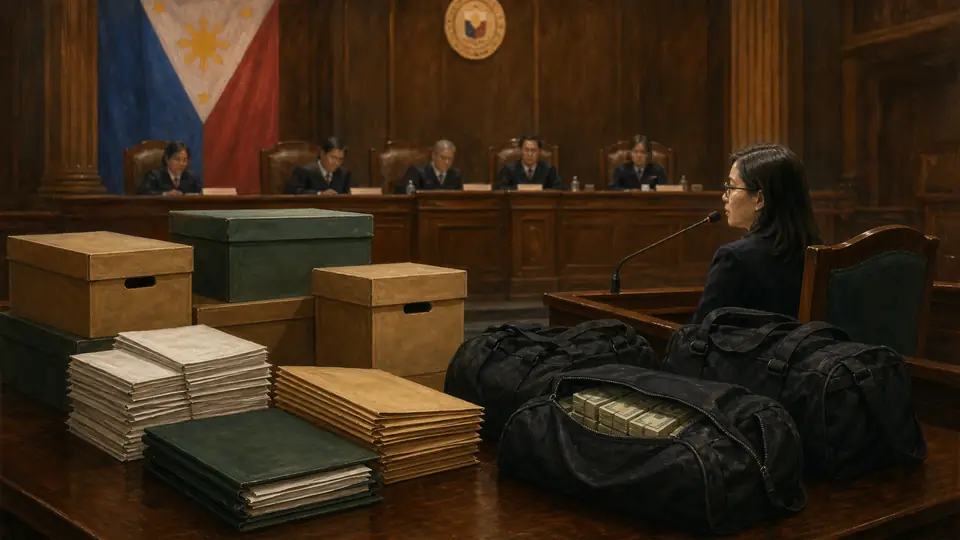
Violeta Constantino, former manager of the Shaw Boulevard branch with 32 years in banking, said she oversaw the encashment of four checks worth 125 million pesos each, 500 million pesos in all. She testified that representatives of the vice president's office, led by special disbursing officer Gina Acosta, carried the cash out in three to four gym bags after it was released in one million peso packs from the branch back room. "Gym bag po. Iba po kasi 'yung duffle bag sa bangko," she said. Bank staff did not help carry the bags, she added, citing a policy that keeps the bank hands off once cash is released.
Constantino called the transactions unusual but not suspicious, saying the office was a legitimate government client. Prosecutors said the office's own report to the Commission on Audit showed the 125 million pesos withdrawn in December 2022 was spent in 11 days, and that her account matched a former aide's claim about bags of cash.
Nenita Camposano, former manager at the LandBank branch serving the Department of Education, also testified on withdrawals. Off the floor, an ethics complaint was filed against Senator judge Pia Cayetano over an allegedly spliced video of prosecutor Chel Diokno, and Senate President Sherwin Gatchalian said detained senators Rodante Marcoleta and Jinggoy Estrada had not filed any request to take part in the trial.
Day 11: Fifteen Boxes, and the Names on the Receipts
On Monday, August 3, the prosecution called Commission on Audit auditor Roderick Wamil, who worked in the agency's Intelligence and Confidential Funds Audit Office. Private prosecutor Lorna Kapunan opened by wheeling in 15 boxes labeled confidential funds and said Wamil alone would identify 50 exhibits covering 3,664 documents, including 3,617 acknowledgment receipts. The defense agreed to most of them, sparing the court 10 of the 15 boxes, but refused to vouch for 845 receipts from the office's late 2022 spending.
Wamil testified that neither former vice presidents Jejomar Binay nor Leni Robredo had confidential fund allocations, so the only offices he audited for such funds were Duterte's. He said nearly 29 million pesos in receipts were undated or issued late, some dated December 2023 for spending a year earlier, and at least one before the funds were released.
The moment that carried came when Kapunan read the names on the receipts, among them Andy Lim, a homophone for the Filipino phrase "ang dilim," meaning very dark, and Alejandro Pikit, where pikit means eyes closed. Defense counsel Michael Poa objected that she was putting color into the names of supposed recipients, and Escudero reminded the veteran lawyer that she understood the objection.
In housekeeping, the court gave BDO Unibank and Security Bank until August 13 to finish submitting Duterte's records. Prosecutor Terry Ridon again asked the vice president to appear at her own trial, now in its fifth week and 11th day. An Octa Research survey released the same day found 43 percent of Filipinos considered bribery the strongest charge against her, ahead of the confidential funds allegation at 28 percent.
Day 12: 'Confidential' Furniture and the 'Scam' Line
On Tuesday, August 4, Wamil returned to the stand. He testified that at least 129 million pesos of the office's 250 million peso allocation for the first two quarters of 2023 lacked supporting documents, part of more than 200 million pesos he said was not properly documented, in violation of the 2015 joint circular. He explained that failure to properly liquidate creates a prima facie presumption that the accountable officer used the money personally, and that Duterte was the accountable officer for both offices.
Wamil said confidential funds went to tables, chairs, printers, and computer equipment backed only by acknowledgment receipts, where the rules call for sales invoices and official receipts. He also testified that core staff of the vice president's office lobbied the Commission on Audit in 2023 to downgrade the audit findings.
The day's sharpest line came from Kapunan, who called the office's handling of the funds a scam. Poa objected, and Escudero struck the word from the record. Outside the chamber, she said it again to reporters: "Ang iniiscam, taong bayan. Ang worth ng scam na 'yan, P612.5 million."
The defense pushed back on the substance. Poa argued the findings were preliminary, contained in an Audit Observation Memorandum, that Binay's 2014 allocation predated the 2015 circular, and that no rule bars spending 125 million pesos in 11 days. Lead defense counsel Sheila Sison also objected to marking part of an unnotarized affidavit by Arturo Lascanas, a self described former member of the Davao Death Squad, arguing no competent witness had identified it.
What Went Viral, and the Arguments Splitting Your Feed
The gym bags dominated. Constantino's account of 500 million pesos carried out in three to four bags, and the detail that 125 million pesos was spent in 11 days, spread across feeds faster than any legal point in the trial. Close behind were Kapunan's plays on the receipt names, Andy Lim and Alejandro Pikit, clipped and captioned within the hour, and her scam line, which traveled widely even after it was struck from the record.
Anti Duterte pages ran the missing receipts, the confidential furniture, and the lobbying claim as a picture of unaccounted money. Pro Duterte pages ran the counters: that the bank manager called the withdrawals unusual but not suspicious, that Wamil's findings sat in a preliminary memorandum, that Binay once had similar funds, and that the defense had declined to call any document fake, saying only that it could not vouch for them.
The reader test this phase is a plain one. An unusual withdrawal and a missing receipt raise questions, but neither is by itself proof that money was stolen. What the cash bought, and whether the gaps mean misuse or paperwork, is exactly what the trial still has to decide.
What the Money Phase Settled and What It Did Not
The prosecution has now put the cash withdrawals and the liquidation gaps on the record. It has not yet shown where the money went, which is the harder task and the one remaining Commission on Audit witnesses are meant to address.
The prima facie presumption Wamil described shifts some weight onto the defense to explain the undocumented sums, but it is a presumption the defense can still rebut. As with the threats charge, conviction on Article I would need at least 16 of the 24 senator judges.
Why Mindanao Is Watching
Part of the money in question was spent while Duterte led the Department of Education, but the political weight of the case still runs back to Davao, where her family remains the dominant force. A charge built on cash, receipts, and audit findings is harder to frame as pure persecution than a disputed video was, which raises the stakes for how the region reads it.
The test in Davao and across Mindanao will be whether the audit case looks like accounting or like a hunt. Testimony that stays with the documents will read as due process. Rhetoric that outruns the evidence, on either side, will feed the divide already visible in the region. This article covers only Days 10 to 12, from July 29 to August 4.
Frequently Asked Questions
What are confidential funds, and how much is in question?
Confidential funds are public money released for intelligence or surveillance work, liquidated under a 2015 joint circular rather than with ordinary receipts. Article I accuses Duterte of misusing 612.5 million pesos in such funds across the Office of the Vice President and the Department of Education in late 2022 and 2023, when she headed both. The prosecution says much of it was withdrawn as cash and liquidated with acknowledgment receipts alone.
Sources and verification
Reader response
- Views
- 5
- Shares
- 0
- Rating
- Not rated
- Comments
- 0