Davao infrastructure
Paolo Duterte Fires Back as Ombudsman Asked to Probe Davao Flood Control Contracts
May 26, 2026 · Joshua S Bariñan
A complaint over 80 Davao City flood control contracts put Representative Paolo Duterte’s ₱49.84 billion infrastructure defense beside claims about red flags, DPWH records, and the city’s first district budget fight.
Key Takeaways
- The filing is a request for investigation, not a final finding of corruption.
The flood came first
The latest fight over Davao City infrastructure did not begin in a committee room. It followed hours of heavy rain from the evening of May 18 into the early morning of May 19, 2026. Overflowing rivers and creeks forced residents in several low lying Davao communities out of their homes. By the next day, the political argument had moved to the Office of the Ombudsman.
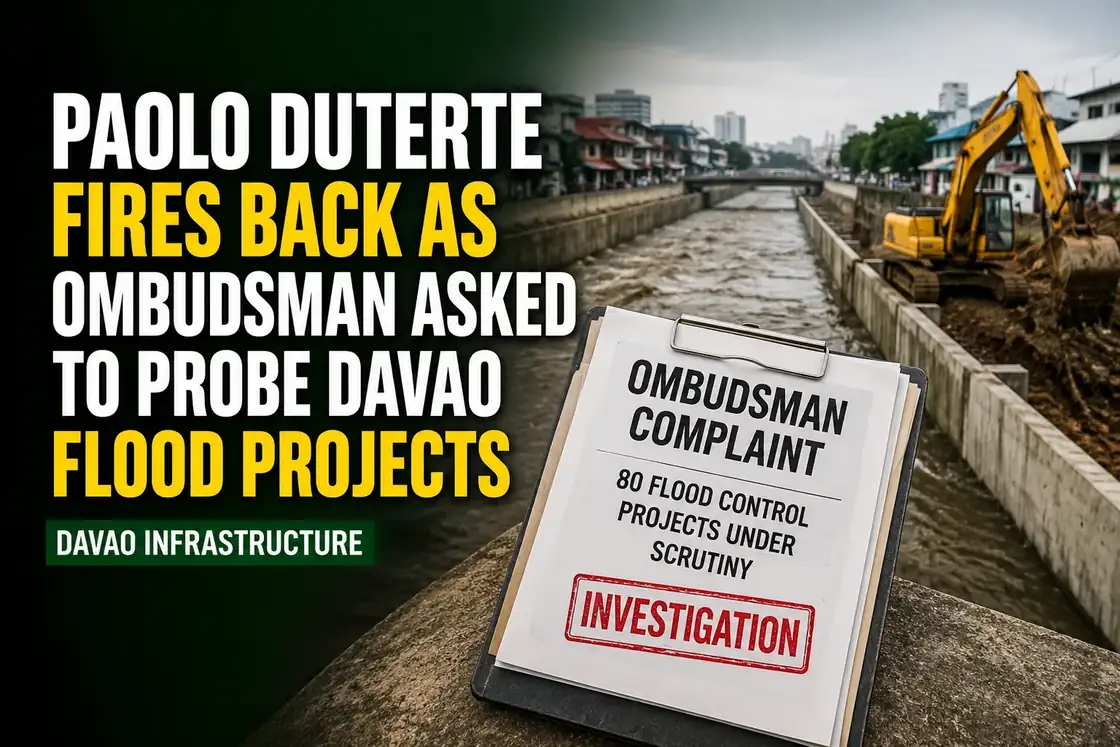
ACT Teachers party list Representative Antonio Tinio asked Ombudsman Jesus Crispin Remulla to investigate flood control projects in Davao City’s first district. His complaint was built on an ACT Teachers review of 121 DPWH recorded flood control contracts along the Davao and Matina rivers from 2019 to 2022. Tinio said 80 of those contracts carried red flags worth about ₱4.44 billion.
For residents, the issue is practical. Davao had just flooded again. The projects under question were supposed to manage water, river flow, and risk. If the structures were properly built, the records should show it. If the contracts were duplicated, incomplete, or poorly documented, residents deserve a clear accounting.
What Tinio is asking the Ombudsman to check
Tinio’s filing does not prove corruption by itself. It asks investigators to test the paper trail against the ground. The complaint points to alleged overlapping scopes, double funding, wrong project locations, missing technical details, incomplete works, and contracts that Tinio said could not be matched cleanly to basic project identifiers.
GMA News and Philstar reported several of the figures Tinio cited: two contracts worth ₱135 million allegedly covered the same river sections, one ₱115 million project allegedly appeared twice in the 2020 national budget and went to different contractors, and eight projects worth ₱425 million were allegedly built in locations different from those authorized.
Philstar also reported Tinio’s claim that 65 contracts worth ₱3.65 billion lacked specifications needed for verification, while 10 contracts worth ₱623 million allegedly had no line item in the national budget. GMA and other outlets reported Tinio’s separate claim that Genesis88 Construction Inc. received 10 contracts worth ₱713 million. Tinio said 49 of the 80 red flagged contracts were congressional insertions concentrated in Davao City’s first legislative district.
Pulong’s answer: the projects are there
Davao City 1st District Representative Paolo “Pulong” Duterte rejected the complaint as political. His response leaned on DPWH Region XI records, saying infrastructure projects in Davao City from 2020 to 2022 reached about ₱49.84 billion and were completed and above standard.
Duterte said the work covered roads, bridges, drainage systems, flood control structures, and other public works that Dabawenyos continue to use. NewsWatch Plus reported the same defense: DPWH Region XI recorded roughly ₱49.84 billion in completed and “above standard” infrastructure projects from 2020 to 2022, including roads, drainage, and bridges.
Duterte’s answer does not close the narrower question. A city can have real roads, bridges, and drainage projects while specific contracts still need accounting. The ₱49.84 billion figure describes a broad infrastructure portfolio. Tinio’s complaint is narrower: 80 flood control contracts along the Davao and Matina rivers that he says should be physically checked.
The zero budget claim has history
Duterte also repeated a line that has become central to his budget politics: he said Davao City has had zero budget for four years. That should be read carefully. It is Duterte’s claim about national budget support for his district, not a settled audit finding in the Ombudsman case.
SunStar Davao reported in January 2026 that Duterte said Davao City’s first district had not received national government budget since 2022. The same report cited a PCIJ finding that Duterte and allied lawmakers Isidro Ungab, Pantaleon Alvarez, and Khymer Olaso had no allocables in the 2025 General Appropriations Act, while other national figures received large allocations from 2023 to 2025.
The budget grievance goes back further. In January 2024, Duterte opposed the people’s initiative for charter change and said about ₱2 billion had been taken out of the National Expenditure Program budget for Davao City’s first district, leaving only ₱500 million. Manila Bulletin and SunStar both reported that claim at the time.
What Davao residents need answered
Duterte’s broader point is that Davao’s infrastructure from 2020 to 2022 was not imaginary. Tinio’s point is that some flood control contracts may be technically irregular, poorly documented, or unfinished. Those two statements can exist in the same city at the same time.
The Ombudsman process now has to separate three questions that politicians often mix together. First, were the 80 contracts properly funded, awarded, located, documented, and completed? Second, did the completed structures actually reduce flood risk in the communities they were meant to protect? Third, has Davao City’s first district been denied later budget support as political punishment, as Duterte claims?
For people in Matina, Maa, Bunawan, Bangkal, Catalunan Grande, and riverside communities that were hit by the May 18 to 19 flooding, the answer cannot just be anti Duterte or pro Duterte. It has to be maps, contracts, site inspections, completion records, and public accounting that ordinary residents can understand.
Frequently Asked Questions
Is the complaint already proof of corruption?
No. It is an allegation and request for review. The relevant question is what official investigators can verify from records, project sites, and audit trails.
Reader response
- Views
- 23
- Shares
- 0
- Rating
- Not rated
- Comments
- 0