City Council
Davao City Puts Its Waste to Energy Plant on a 2029 Clock as IDIS Weighs a Court Challenge
October 9, 2026 · Joshua S Bariñan
Councilor Temujin Ocampo told a media forum that the Japanese funded incinerator in Tugbok should be running by 2028 or 2029, days before Crown Agents Japan opened procurement for the plant. The environmental group IDIS answered with a statement calling the project a step backward and said it is reviewing documents for possible legal action.
The city expects the incinerator to produce about 13 megawatts, keep 2 for its own use, and sell 11 to the grid. Construction cannot start until the Japanese side finishes bidding, which Crown Agents Japan opened on October 7, 2026.
What the city announced
Councilor Temujin Ocampo, who chairs the City Council committee on environment and natural resources, gave the timeline at the Isyu Karon forum at The Royal Mandaya Hotel on Friday, October 2, 2026. He said the city is still working with the Japanese government under an existing memorandum of agreement and that the plant will sit on a nine hectare site owned by the city in Sitio Pungot, Barangay Biao Escuela, Tugbok District.
The schedule depends on procurement and construction, Ocampo said, and the Japanese side controls the bidding. Davao Today reported that Crown Agents Japan announced on October 7 that it had opened procurement for the design, construction, operation, and maintenance of the facility under the Japanese grant. The Environmental Management Bureau in Region 11 held public scoping for the project on April 15, 2026.
The plant is designed to burn about 600 tons of garbage a day. Davao City produces 700 to 800 tons daily according to a March 2026 project document from the bureau, so the city would still need landfill space or other handlers for the rest. Councilor Danilo Dayanghirang raised that gap when the council took up the bond in September.
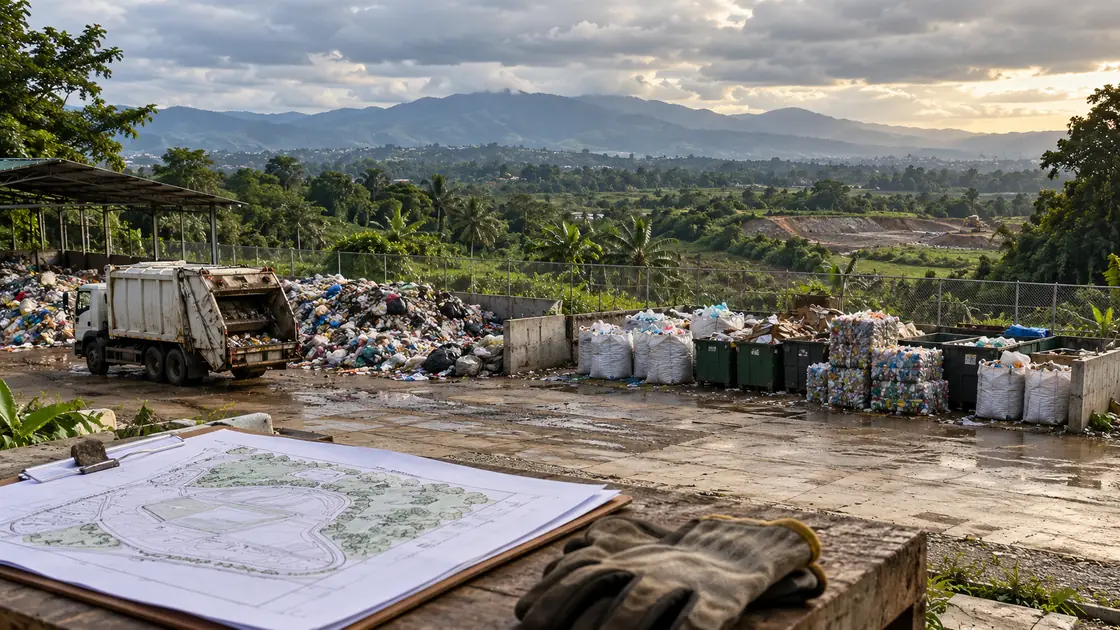
Ocampo said garbage collection continues despite occasional delays as the city moves operations to the new cell at New Carmen beside the closed dumpsite. The city has bought new trucks and still uses private haulers, including contractors serving some subdivisions.
How the P11 million bond works
On September 8 the council released P11 million from the General Fund Proper Guarantee Deposits Account to post a bid bond in the Department of Energy's special auction round for thermal waste to energy projects. The bond is set at P1 million per megawatt of the plant's expected 11 megawatt net output. Genevieve Gamueta, assistant project manager for the project, presented the measure under suspended rules because the DOE had only sent its list of qualified bidders on September 4.
The auction round was launched on December 30, 2025, and covers 230 megawatts of capacity nationwide with delivery due between September 1, 2028, and March 31, 2029. That window is what sets the city's completion target.
Ocampo explained at the forum that the bond is refundable if the city does not win or advance. If the bid succeeds it converts into a performance guarantee tied to finishing the plant. Gamueta told the council that a winning bidder must post a separate performance bond of about 3 percent of construction cost, roughly P114 million, and complete the facility within three years or forfeit it.
The point of joining the auction is price. Gamueta said the city could lock in an electricity sales rate of up to P9.29 per kilowatt hour, which would let it cut the garbage tipping fee it pays the operator from a cap of P1,500 per ton to about P700. Japan's grant for the project, signed in an exchange of notes on March 20, 2018, is worth about 5 billion yen, and earlier financing talks assumed billions of pesos in Philippine counterpart funds on top of it.
Why IDIS is fighting it
Interfacing Development Interventions for Sustainability issued a statement on the city's auction bid and followed it up at the Davao Peace and Security Press Corps on Wednesday, October 7. Executive director Mark Peñalver said joining the Green Energy Auction Program for an incinerator pulls the city away from the gains of its circular economy work, which puts prevention, reuse, recycling, and composting ahead of disposal.
Peñalver's central argument is that incineration is not green energy. He cited the United Nations Environment Programme, which treats thermal waste to energy as a treatment option of last resort to be used only after higher priority measures are working. He also said that dioxins and furans, while regulated under the Clean Air Act, build up in the body and in livestock over years of exposure even when a plant's emissions stay within standards.
The group added a water argument tied to the coming El Niño. Peñalver said incinerators need thousands of cubic meters of water a day for cooling, and that during a severe drought that demand would compete with household supply, which the Water Code puts first.
On legal action, Peñalver said the group is reviewing the project documents. He said IDIS may consider legal remedies and called that part of due process. The group's statement said the city should instead fund Materials Recovery Facilities in all 182 barangays, enforce a no segregation, no collection policy, and back community recycling groups.
The segregation problem both sides agree on
Ocampo and IDIS disagree on the plant but agree that the city's sorting habits are not ready for it. Ocampo said the incinerator needs dry, combustible feedstock with enough calorific value, and that food waste, wet material, diapers, and medical waste should not go in. He said the city will enforce its 2010 Solid Waste Management Ordinance more strictly before the plant opens, with organic waste going to composting sites or accredited private processors and hospital waste to dedicated treatment plants.
The numbers show how far the city has to go. Davao Today reported that of 182 barangays, 53 have Materials Recovery Facilities, 116 have smaller Materials Recovery Stations, 47 have composting facilities, and 96 meet compliance standards. Lakandiwa Orcullo, who heads the waste management division at the City Environment and Natural Resources Office, acknowledged that some barangays keep facilities for compliance without fully using them.
Residents told Davao Today that sorting at home is undone at the collection point. Lenette Cambalon, who runs an eatery in Barangay 32-D, said collectors mix everything into sacks. Emelita Sumas in Barangay 11-B said resident IDs meant to control who dumps at the barangay point are rarely checked, and outside vendors use it anyway.
Peñalver said the public understanding is that all trash will be burned, when only residuals should be. The city's own 2018 to 2027 solid waste plan, approved in December 2019, projected diversion rising from 31 percent in 2017 to 92 percent by 2027 with the incinerator carrying much of the increase.
What happens next
Emissions oversight falls to the Department of Environment and Natural Resources and its Environmental Management Bureau. Ocampo said the agencies would run continuous stack monitoring with automatic alerts, the same approach used at other industrial plants, and that city officials and Japanese counterparts have visited operating incinerators and the communities around them in Japan.
The next visible steps are the Crown Agents Japan procurement, which will pick the contractor, and the DOE auction result, which will set the power price and start the three year completion clock. IDIS has not filed anything yet. Its review of the documents will decide whether the project faces a court case alongside its environmental permitting.
A video circulating online of a finished Davao waste to energy complex is computer generated. Mindanao Daily News columnist Ray Talimio Jr. noted the plant does not exist yet and the project was still in environmental approval this year.
Sources and verification
Reader response
- Views
- 5
- Shares
- 0
- Rating
- Not rated
- Comments
- 0