Bangsamoro Autonomous Region in Muslim Mindanao / Lanao del Sur / Marawi
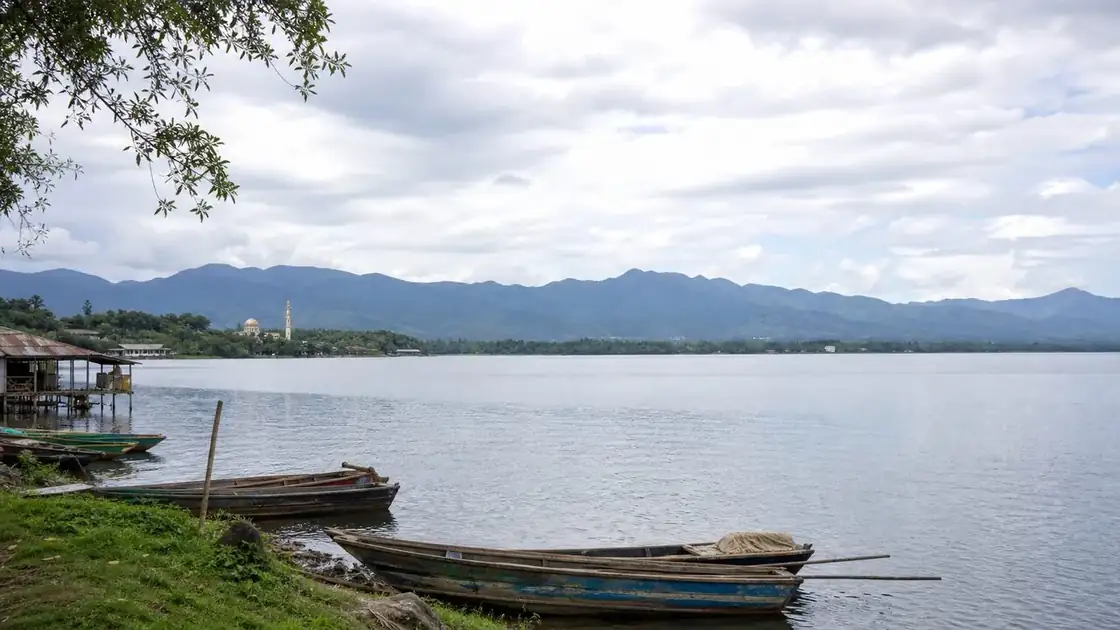
Lake Lanao
Edited by Joshua S Bariñan
Best for
- Lake context
- Marawi
Map address
Place guide
Updated June 2026
The Lake At The Center Of Maranao Life
Lake Lanao is the largest lake in Mindanao and one of the 15 ancient lakes in the world. For the Maranao, or "People of the Lake," it is the main feature of their cultural and political identity.
The traditional Maranao royal houses, or torogan, were designed to mirror the lake's navigation. These ancestral homes are elevated on wooden posts called tukud, which rest on rounded boulders so the structure can sway during earthquakes.
This design mimics a royal vessel, or awang, floating on the water. The most recognizable feature of the torogan is the panolong, a winglike beam protruding from the front of the house.
These are intricately carved with okir motifs, often depicting the naga (sea serpent), which resembles the prow of a traditional boat. Traditional life here is organized around the "pat a pangampong ko ranao," the four principalities of Lanao, which distribute territory and leadership roles according to their proximity to the lake shore. Its deepest sections reach more than 100 meters, making it one of the country's deepest lakes.
Hydropower And The Mindanao Grid
The lake is the main reservoir for the Agus Hydropower Complex, a cascade of seven power plants (Agus 1 through 7) that provides approximately 30 percent of Mindanao’s total electricity. The Agus River drains the lake northward toward Iligan Bay, dropping 700 meters in elevation along its short 36 kilometer course.
As of June 2026, the complex is undergoing a PHP 20 billion rehabilitation led by the Power Sector Assets and Liabilities Management Corp. (PSALM) to restore its aging units to their full 1,001 MW capacity.
Water level management is a delicate balance between power generation and the needs of the lakeshore communities. If the lake level drops too low, it affects local irrigation and the stability of the torogans built near the water.
Conversely, excessive drainage is needed to power the turbines downstream. This makes Lake Lanao a water resource of national economic importance and a continuing subject of environmental concern in the Philippines. Its outlet is the Agus River, linking Marawi and Lanao del Sur to Iligan hydropower and Maria Cristina Falls.
Ecology Of An Ancient Lake
Lake Lanao is a rare "ancient lake," meaning it has been continuously filled with water for millions of years, allowing for the evolution of unique endemic species. Historically, the lake was home to 18 endemic species of cyprinids (freshwater fish), many of which are now critically endangered or extinct due to the introduction of invasive species like the Janitor fish and Nile tilapia.
Conservationists and researchers are currently working to document the remaining native populations and manage agricultural runoff to prevent further algal blooms. The lake’s isolation on a high plateau once protected its biodiversity, but modernization and increased human activity have brought new pressures. Efforts to have Lake Lanao declared a UNESCO World Heritage site are ongoing, based on its ecology and its long standing cultural importance to the Maranao people.
2026 Visit Logistics and Marawi Recovery
Visiting Lake Lanao today involves navigating the post-2017 Marawi landscape. The Most Affected Area (MAA), once ground zero for the five month siege, has been rebuilt with new public landmarks that face the lake. The Sarimanok Sports Stadium, the Marawi Convention Center, and the Grand Padian Market now offer some of the best vantage points for observing the lake’s vast horizon.
Traditional boat racing, or kapagawang, has been revived at the shoreline as part of the city’s cultural recovery programs. Travelers should be aware of current security protocols, including a "fishing lockdown" typically in effect from late evening to early morning for security monitoring.
The Marawi Port is the primary point for local boat traffic to the 18 municipalities surrounding the lake. While the city is open to visitors, it is best to coordinate with the Lanao del Sur Provincial Tourism Office for current access rules and to arrange visits to traditional sites like the Kawayan Torogan in Marantao, which remains a National Cultural Treasure.
- Surface Area
- 347 square kilometers
Frequently Asked Questions
Is it safe to visit Lake Lanao in 2026?
Yes, Marawi City and the lakeside municipalities are open to visitors, but security remains a priority. Travelers should coordinate with local tourism offices, follow evening lockdowns on the lake, and stick to established landmarks like the new Sarimanok Sports Stadium.
What are the Agus 1 to 7 dams?
The Agus Hydropower Complex is a series of seven hydroelectric plants that use the water flowing from Lake Lanao to the Agus River to generate about 30% of Mindanao’s electricity. They are currently undergoing a major multiyear rehabilitation program.
Where can I see a traditional torogan?
The Kawayan Torogan in the municipality of Marantao, just outside Marawi, is the most famous surviving example and is a National Cultural Treasure. Several other torogans are located within Marawi City, though some are in various states of preservation.
What is the "People of the Lake"?
The name "Maranao" (or Meranaw) literally translates to "People of the Lake." Their culture, language, and ancestral traditions are all fundamentally tied to the geography and resources of Lake Lanao.