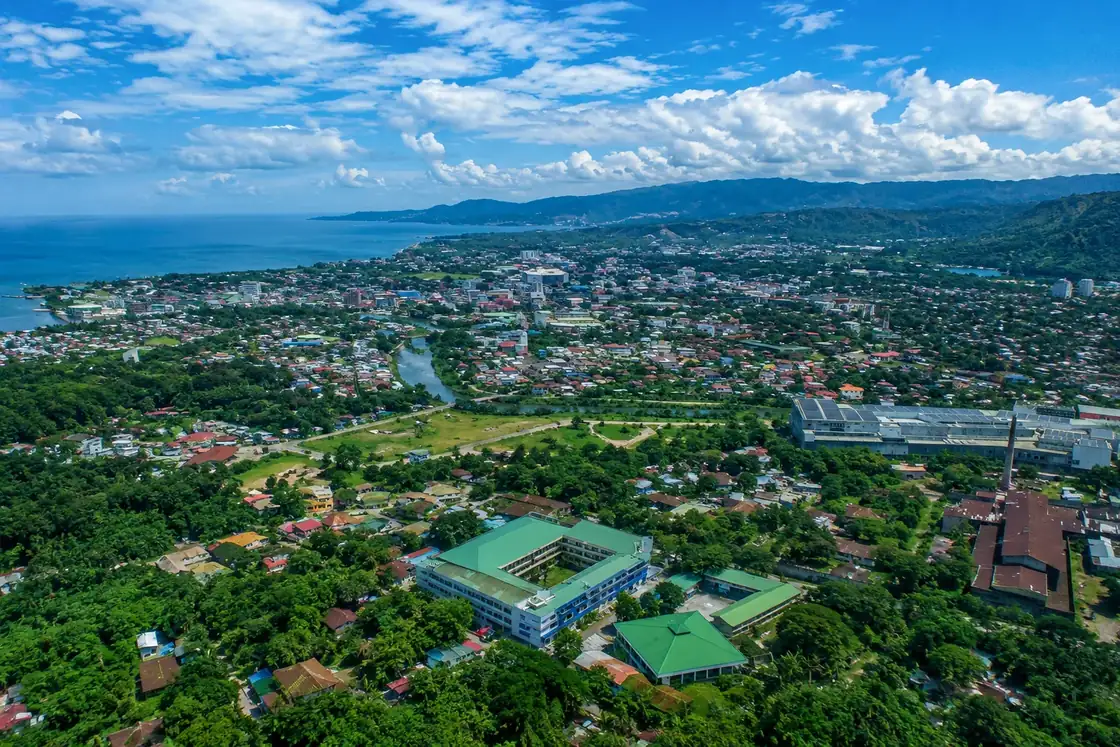
Iligan is a highly urbanized city at the mouth of Iligan Bay, known for Maria Cristina Falls, the Agus River hydropower complex, and a steel industry history that shaped the city’s economy for decades. The National Steel Corporation was once Asia’s largest steel mill at 1.2 million tons annual capacity by 1992. It closed in 2009 after a period under private ownership by Ispat Industries, leaving an estimated 14,000 workers directly unemployed and a 400-hectare industrial site still idle as of 2025. The closure cost the city an estimated 3 billion pesos in unpaid taxes and over 1.4 billion pesos in annual industry losses. The Agus-Pulangi Hydroelectric Complex, which includes seven plants with roughly 1,000 MW of installed capacity, is managed by PSALM. Only about 600 to 700 MW is typically operational due to aging equipment and water flow variability. In 2025 and 2026, Iligan City strongly opposed privatization proposals for the complex. Mindanao State University Iligan Institute of Technology was established in 1968 and enrolls between 10,000 and 14,999 students across 54 graduate programs and nine degree-granting colleges. The campus connects the city to engineering, science, and technology education in a way that has partially offset the industrial losses.
Quick answer
- Mayor:
- Frederick W. Siao
- Population:
- 368,132 (PSA POPCEN 2024)
- Income class:
- 1st class
- Known for:
- City of Majestic Waterfalls, home to Maria Cristina Falls (NPC hydropower source) and Tinago Falls, plus industrial heritage from the National Steel Corporation era
- Maria Cristina Falls:
- Twin drop waterfall on the Agus River, approximately 98 meters high. It is a primary power source for the NPC/PSALM Mindanao grid and a major Iligan landmark.
- Tinago Falls:
- Hidden waterfall accessible by stairs and boat across a gorge pool, roughly 55 meters high, known for emerald green water and a steep canyon descent
- Industrial history:
- National Steel Corporation (NSC) site where Iligan was once the center of Philippine heavy industry, with steel, fertilizer, and chemical plants powered by Agus River hydroelectricity from the 1960s onward
- Festival:
- Diyandi Festival (September), celebrating Iligan’s diverse communities and cultural heritage
- How to reach:
- By bus or van from Cagayan de Oro (1 to 1.5 hours) or from Marawi/Lanao del Norte. No commercial airport; Laguindingan Airport (CDO) is the nearest air link.
- Maria Cristina Falls
- Tinago Falls
- Iligan Bay
- City center
Local context
Iligan's current mayor reference on this page is Frederick W. Siao. PIA reported Frederick W. Siao was proclaimed re-elected Iligan City mayor after the 2025 local elections. Source label: PSA PSGC Region X cities, 2024 POPCEN.
Iligan is linked to local place pages including Maria Cristina Falls, Tinago Falls. Those pages help separate the city guide from a generic location summary by giving readers concrete markets, parks, transport corridors, civic districts, and visitor routes to compare.
The city profile emphasizes Maria Cristina Falls, Tinago Falls, Iligan Bay, City center. These points give the page a practical local frame instead of treating the city as only a name on a regional map.
Landmarks and orientation points
- Maria Cristina Falls
- Tinago Falls
- Iligan Bay
- City center
FAQ
What region is Iligan City in?
Iligan City is a highly urbanized city in Lanao del Norte province, within Northern Mindanao (Region X). Despite being in Lanao del Norte, Iligan is governed as an independent HUC and is distinct from the province’s other municipalities. Its proximity to Marawi City (about 30 kilometers away) makes it a link point between Northern Mindanao and the Bangsamoro Autonomous Region in Muslim Mindanao (BARMM).
How do you visit Maria Cristina Falls in Iligan?
Maria Cristina Falls is 9.3 kilometers southwest of Iligan City center, in Barangay Maria Cristina at the Agus 6 Hydroelectric Plant complex managed by PSALM. From the city center, take a jeepney toward Buru-an or Linamon and ask the driver to drop you at the Maria Cristina Falls corner. From there, hire a habal-habal to reach the falls viewing area. Entrance fees are ₱20 to ₱35 per person, with multicab tour rides available for ₱10. Verify gate hours and current flow status before the trip, since water may be diverted for generation during dry season or high grid load.
What is Tinago Falls?
To get to Tinago Falls, take a jeepney from the Iligan city center toward Buru-un for ₱15 to ₱20, then hire a habal-habal for ₱50 to ₱80 to the falls entrance. There are two main approach routes: one through Buru-un and one through Linamon at Highland Resort road. Entrance is ₱25 per person, with a raft ride across the gorge pool for ₱10 per person plus a life vest fee. Budget around ₱200 to ₱300 total per person for transport and entry. Wear grip footwear and expect a steep descent and return climb.
What was the National Steel Corporation in Iligan?
The National Steel Corporation was a government-owned integrated steel mill built in Iligan City in the 1970s to use cheap hydroelectric power from the Agus River. Ispat Industries acquired the NSC in 2004 and ran it until the 2009 closure. The NSC site sits in Barangay Kiwalan, and various redevelopment proposals have not advanced into active construction. The industrial complex shaped Iligan's urban geography, labor history, and fiscal capacity in ways that continue to matter today.
Is Iligan City safe to visit?
Iligan City itself is generally safe for domestic tourism by Philippine urban standards. The city is distinct from Marawi City, which is approximately 30 kilometers away and is still in post 2017 rehabilitation. Iligan hosted large numbers of Marawi evacuees during and after the 2017 siege, and the two cities are socially and economically interconnected. For waterfall visits, the main safety concerns are physical: the stairs at Tinago are steep, and access at Maria Cristina depends on gate rules. Monitor national travel advisories for Lanao del Norte during periods of elevated security alerts.
What is Diyandi Festival?
Diyandi Festival is the major annual cultural celebration of Iligan City, held in September. It honors the diverse communities that make up the city, including Christian settlers, Maranao neighbors, Cebuano migrants, and Indigenous groups, and commemorates the city’s founding. The festival includes street dancing, cultural performances, trade fairs, and civic events. The 2025 Diyandi featured more than 130 activities across 30 days. The name and celebration reflect Iligan’s position between Northern Mindanao’s Christian majority areas and the Muslim Lanao communities.
What is MSU-IIT and how does it shape Iligan City?
Mindanao State University Iligan Institute of Technology was established by Republic Act 5363 in 1968 and became MSU's first autonomous unit in 1975. The campus is in the Iligan city center and covers engineering, science, education, arts, and business. MSU-IIT is regarded as one of the leading engineering and science universities in Mindanao, drawing students from Lanao del Norte, BARMM, and wider Mindanao.
How do you travel between Iligan and Marawi?
Iligan City and Marawi City are connected by a 30-kilometer national highway, with typical travel time of about 38 minutes by car, taxi, or van. Vans and other public transport operate between the cities depending on terminal schedules. The road was confirmed safe for regular travel in 2022. Marawi is the next major city on the road that continues into Lanao del Sur and BARMM territory. Iligan served as the main evacuation and relief staging point during the 2017 Marawi siege, and the two cities remain economically linked through trade, services, and family connections. Many families displaced from Marawi in 2017 settled in Iligan and continue to pay rent there while maintaining ties to Marawi.
What are the flood risks in Iligan City and what happened with Typhoon Sendong?
Iligan has three principal rivers draining into Iligan Bay: the Agus, the Mandulog, and the Iligan River. Typhoon Sendong in December 2011 caused catastrophic flash flooding that killed 490 people in Iligan, with water rising 7 to 10 meters in the main rivers within hours. Two national highway bridges were destroyed and 1.7 billion pesos in infrastructure damage was recorded. Upstream deforestation in the Mandulog watershed was cited as a contributing factor by post-disaster studies. The city has ongoing drainage and flood control projects, but the upstream land use issue means flood risk remains tied to logging and quarrying activity in the surrounding mountains.