Environment
Zamboanga City Air Hits the Emergency Band at Noon as Indonesian Haze Returns to Mindanao
October 15, 2026 · Joshua S Bariñan
Six weeks after the first wave of smoke from Kalimantan reached Mindanao, the Department of Environment and Natural Resources recorded the worst reading of the season in Zamboanga City on Wednesday. The index at the Ateneo de Zamboanga University station in Tumaga crossed into the emergency band at midday, the top of the Philippine scale, then dropped two bands by late afternoon. Stations in Cagayan de Oro, Iligan and Malita in Davao Occidental sat in the sensitive groups band the same day. Across the strait the same haze has closed schools in Malaysia and Timor Leste and pushed Singapore to its highest fine particle reading since 2015.
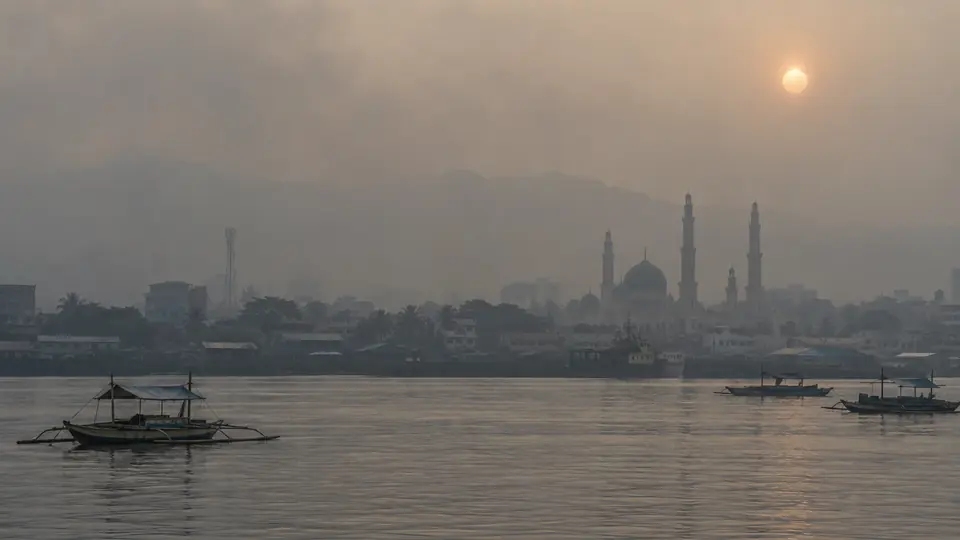
What the Tumaga station recorded
The Environmental Management Bureau's monitor at Ateneo de Zamboanga University in Barangay Tumaga logged fine particulate matter, or PM2.5, in the emergency band at noon on Wednesday, October 14. By the bureau's 5 p.m. advisory the index had fallen to the very unhealthy band, between 151 and 200. The city's second station, at Western Mindanao State University's San Ramon campus in Talisayan, was in the acutely unhealthy band earlier in the day and in the unhealthy for sensitive groups band by 5 p.m.
The bureau said the smoke was possibly associated with transboundary haze from fires in Kalimantan, Indonesia carried north by the prevailing wind. Its advice was the same as in September: cut back prolonged time outdoors, keep children, older people and anyone with heart or lung disease inside, and wear a mask, preferably an N95, when going out.
The Philippine index has six bands. Good runs to 50 and fair to 100. Unhealthy for sensitive groups covers 101 to 150, very unhealthy 151 to 200, and acutely unhealthy 201 to 300. The emergency band above that is the one Tumaga reached.
Zamboanga was among the cities hit hardest in the first wave. At 6 a.m. on September 3 the EMB placed it in the very unhealthy band, the same morning Metro Cebu's index reached 252.
Northern Mindanao and Davao Occidental
EMB Region X published its own readings for October 14 as 24 hour rolling averages: Tagoloan 127, unhealthy for sensitive groups; Iligan City 92, fair; and the Cagayan de Oro station at the DENR regional office 99, fair. The office said pollution had decreased but asked the public to stay attentive, and told sensitive individuals to limit prolonged or strenuous outdoor activity when the air worsens. It has also put live data from its continuous monitoring stations online.
The national bulletin reported by Bombo Radyo the same day placed stations in Cagayan de Oro, Iligan, Barangay Culaman in Malita, Davao Occidental, and Meycauayan City in Bulacan in the sensitive groups band. The regional figures smooth a full day of readings, which is one reason the two bulletins can put the same city in different bands at the same hour.
The comparison with September 3 shows how much the north has eased. On that day the Cagayan de Oro City Health Office issued a haze advisory citing government monitoring that put the city in the sensitive groups band, Tagoloan in very unhealthy and Iligan in acutely unhealthy. The office told residents to limit midday and afternoon exposure, wear a fitted N95 outdoors, keep windows and doors shut and run fans or purifiers indoors.
A season that started on August 1
The 2026 Southeast Asian haze has run continuously since the start of August and has touched Brunei, Indonesia, Malaysia, Singapore, Thailand, Timor Leste, Vietnam and the Philippines. The fires are concentrated in Sumatra, Kalimantan and Papua. Forecasters warned in May that the strongest El Niño on record, combined with a positive Indian Ocean Dipole, would dry out peat and vegetation and raise the odds of severe fires in September and October.
Zamboanga City faces the Sulu and Celebes seas toward Borneo, which puts it on the path of smoke moving northeast from Kalimantan before it reaches Cebu, Iloilo or Davao. The city has been here before. In late October 2015 haze from Indonesian fires thinned the view of Paseo del Mar and sent residents to health centers with coughs and eye irritation, though the city health office said then that the pollution index never reached an alarming level. This week's reading went well past that.
In the Philippines the first wave in early September pushed Metro Manila, Calabarzon and Mimaropa into the very unhealthy and acutely unhealthy bands and reached Iloilo, Cebu and Zamboanga. Mindanao Live covered the Davao end of that episode at the time.
Across the strait
Malaysia closed schools in Kuala Lumpur, four states and two federal territories on Friday, October 9, when the capital's pollutant index stood near 170 and a Swiss monitor ranked it the second most polluted city in the world behind Singapore. Prime Minister Anwar Ibrahim said he had spoken with President Prabowo Subianto and asked for an urgent meeting of ASEAN environment ministers. Johor extended its school closures to October 16.
Singapore's western region recorded a one hour PM2.5 reading of 288 at 3 p.m. on October 14, the highest since 2015, and a 24 hour index of 203, very unhealthy, by 9 p.m. The city opened air conditioned haze shelters, began handing out N95 masks and shut some outdoor sports facilities. Timor Leste ordered all schools closed from October 15 to 17.
In Indonesia itself, Pontianak closed dozens of schools as early as August 11, and provincial leaders in Kalimantan have resisted calls to declare a national emergency.
What to watch in the coming days
PAGASA's October 14 advisory had the Intertropical Convergence Zone bringing scattered rains and thunderstorms to the Visayas and Mindanao over the following 24 hours. Rain can scrub particles out of the air locally, but EMB Region 7 said in September that nobody can forecast when the haze will lift because that depends on the fires and the wind, and both are outside Philippine control.
For Zamboanga residents the practical checks are the EMB's hourly advisories and the Region 9 office's station readings. A sensitive groups reading is a reason for people with asthma or heart disease to stay in. A very unhealthy or acutely unhealthy reading is a reason for everyone to cut outdoor time, and the band Tumaga hit at noon on Wednesday is a reason to close the windows and stay home until it passes.
Class suspensions remain a local call. Cebu City halted in person classes in September while Metro Cebu sat in the acutely unhealthy band, and Quezon City did the same. Zamboanga City Hall had not announced one as of Thursday morning.
Sources and verification
Reader response
- Views
- 0
- Shares
- 0
- Rating
- Not rated
- Comments
- 0