Public safety
Undas 2026: more than 14,000 police and volunteers will guard Mindanao cemeteries as cities set hours and bans
October 27, 2026 · Joshua S Bariñan
Police commands across Mindanao have published their Undas 2026 plans. The Davao regional police will field about 6,000 personnel at some 200 cemeteries, Northern Mindanao goes on full alert with more than 7,200 officers and volunteers from October 31, and Zamboanga City assigns 1,463 personnel to 46 burial sites. Davao City keeps public cemeteries open only from 6 a.m. to 8 p.m. between October 30 and November 3 with no overnight stays, while Cagayan de Oro is telling visitors to stay away during the hottest hours of the day.
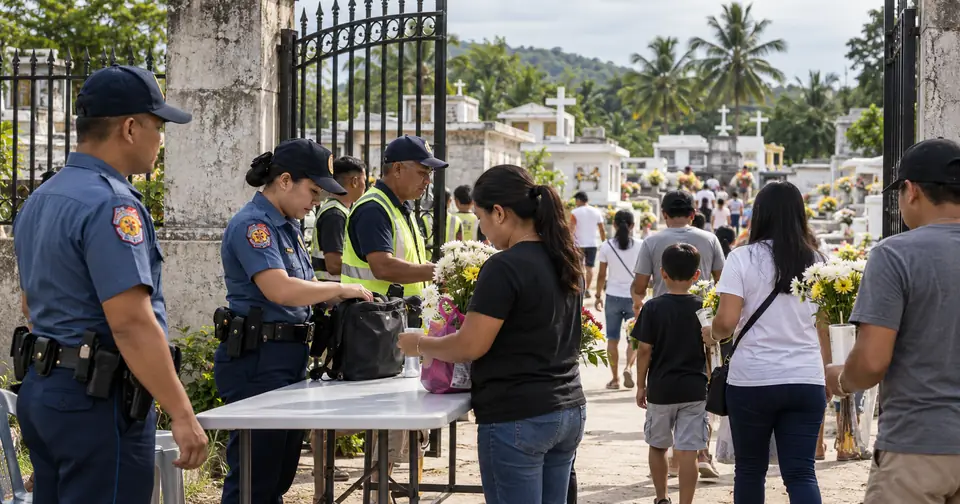
Treat an Undas cemetery visit like a crowded outdoor event: confirm the local schedule before leaving, expect security screening and traffic delays, and choose a cooler morning slot when traveling with anyone vulnerable to heat.
Davao Region puts 6,000 police on the ground
About 6,000 personnel of the Police Regional Office 11 are ready for deployment across the Davao Region, spokesperson Major Catherine Dela Rey said on Davao City Disaster Radio's Seguridad sa Syudad program on October 23. The deployment covers some 200 cemeteries along with churches, transport terminals, tourist spots and other installations, since many families travel during the long weekend.
Acting regional director Brigadier General Benigno Guzman inspected the Wireless Public Cemetery on A. Pichon Street and the Davao Memorial Park on October 21 with his deputy for operations, Colonel James Cipriano, and the chiefs of the two police stations that cover the sites. The inspection checked site readiness, traffic plans and where officers would stand. Full deployment and live situational reporting run from October 29 to November 3.
Dela Rey said there are no new guidelines this year and told the public to check local government advisories and the Facebook pages of police stations and provincial offices for opening and closing hours. Police assistance desks will be set up in cemeteries, memorial parks and columbaria, and officers will be posted along the main roads leading to burial sites to manage traffic and pedestrians. The regional office is also coordinating with local governments to assist senior citizens and persons with disabilities.
In Davao City's Paquibato District, police and Public Safety and Security Auxiliary personnel will cover cemeteries in all 13 barangays, including Malabog, Fatima and Paquibato Proper, Captain Alvin Pinapit of Paquibato Police Station 7 said on the same program. He said the cemeteries in the district's remote barangays are small and that overnight stays are not allowed there.
Davao City's gate rules and the 90 to 10 split
The Davao City Police Office will run a 90 to 10 deployment during Undas, with 90 percent of its personnel on field duty and 10 percent left for administrative work at the stations, spokesperson Lieutenant Colonel Maria Teresita Gaspan told the Davao Peace and Security Press Corps at the Royal Mandaya Hotel. The office is covering more than 40 cemeteries plus the seaport, the airport and the transport terminals.
Gaspan said the office cannot pour everyone into cemeteries and leave regular beats short, because thieves work neighborhoods while families are out. "That's why full force ang kapulisan natin during sa Undas," she said.
Police and auxiliary personnel at cemetery entrances will confiscate bladed weapons, bolos, firearms and tumblers that are not transparent. Matches and lighters get some leeway because visitors light candles, but cigarettes will be taken under the city's smoking ban and the Public Safety and Security Office guidelines, and a lighter used for smoking can go too. Gaspan asked families who clean graves on the day itself to do it earlier, since bolos brought to the gate will be confiscated once the guards are in place.
The city government has set public cemetery hours at 6 a.m. to 8 p.m. from October 30 to November 3 and banned overnight stays. Gaspan said some private cemeteries allow visitors until 9 p.m. Gates close after visiting hours, and police will remain inside some cemeteries overnight.
Northern Mindanao goes on full alert with 7,200
The Police Regional Office 10 will deploy more than 7,200 officers and volunteers from Saturday, October 31, until November 2: 4,044 regular police, 1,059 personnel from allied law enforcement units and 2,103 force multipliers such as barangay peacekeepers and local traffic enforcers. Regional director Brigadier General Nestor Babagay Jr. told his unit commanders that the street presence has to translate into crime prevention rather than a static show of force, and patrols will watch residential neighborhoods for burglaries while families are at the cemeteries.
The heaviest deployment in Cagayan de Oro goes to the 19.8 hectare Bolonsiri Public Cemetery, recently redeveloped as the City Memorial Park. It is the largest site in the city and holds an estimated 40,000 to 50,000 remains, thousands of which were recently exhumed and moved to a centralized ossuary. Five private memorial parks together hold about 35,000 graves. The older public cemeteries are crowded: Bulua squeezes more than 10,000 graves into three hectares, and Carmen holds about 5,000 in two. Police assistance desks will stand at the entrances of the major cemeteries.
The city government said police will be posted at all 20 of its cemeteries from October 30. At an Incident Management Team briefing, officials urged visitors to prepare for high heat and sudden showers and advised the public to avoid cemeteries between 10 a.m. and 2 p.m. Senior citizens, pregnant women and persons with disabilities were encouraged to visit early in the day or before the holiday to skip the crowds and the heat.
Zamboanga City covers 46 sites
The Zamboanga City Police Office will deploy 1,463 personnel: 958 police, 147 from other units and 358 force multipliers including barangay peacekeeping action teams, local government staff and traffic enforcers, officer in charge Colonel Nordave Calderon said in a statement on October 26. The deployment covers 46 sites, 32 public cemeteries, five private cemeteries, six memorial parks and three columbaria, with priority protocols at eight major public and nine major private cemeteries.
Calderon said assistance desks, mobile patrols, inspection checkpoints and safety signage will support traffic and crowd control. He asked residents to follow cemetery rules, secure their homes before leaving and avoid posting their live location online.
City Administrator Percival Ramos said traffic will be rerouted around the large cemeteries, especially those next to highways. Mayor Khymer Olaso is set to issue two orders, one for the rerouting and one banning bladed weapons, alcoholic drinks, sound systems and flask tumblers inside cemeteries. The Philippine Ports Authority in the city is running its own Oplan Biyaheng Ayos for Undas with port operators, shipping firms and security agencies from October 28 to November 3.
What Malacanang ordered for the trip home
President Ferdinand Marcos Jr. ordered law enforcement units to put more personnel, canine units and vehicles at major terminals, ports and other places where travelers gather, and to assist stranded passengers at once, Executive Secretary Ralph Recto said on October 26. Recto directed the transportation, social welfare and interior departments to prepare personnel, vehicles and services for the surge at ports, airports and terminals across Luzon, the Visayas and Mindanao.
The Philippine Coast Guard expects 1.5 million to two million sea passengers over the holiday, and its own Oplan Biyaheng Ayos covers October 29 to November 3. The Department of Transportation was told to line up extra vehicles in case regular trips cannot carry the load and to work with the Land Transportation Franchising and Regulatory Board on bus supply for the busiest routes. Recto also suggested that agencies study random drug testing of public transport drivers under existing rules.
The Department of Social Welfare and Development will stock food, water and other aid for passengers stranded by weather or breakdowns, the Department of Health is readying medical teams, and the Department of the Interior and Local Government will coordinate with local governments and the police on order and security. "It is not enough to have many vehicles. We must also ensure that passengers are safe on the roads, at the ports and at the terminals," Recto said.
Sources and verification
Reader response
- Views
- 4
- Shares
- 0
- Rating
- Not rated
- Comments
- 0