Maritime security
Chinese carrier Liaoning and three destroyers crossed the Basilan Strait 15 nautical miles off Zamboanga del Norte
October 27, 2026 · Joshua S Bariñan
The Armed Forces of the Philippines disclosed on October 26 that a Chinese Navy carrier group led by the Liaoning sailed down the western coast of Mindanao four days earlier, entering off Siocon in Zamboanga del Norte, passing through the Basilan Strait and leaving toward the Celebes Sea late that night. Navy monitoring reports put the closest point at 15.2 nautical miles from Talulu Point. The group had its transponders off and did not answer radio challenges. Two Navy ships, a Coast Guard vessel and two aircraft shadowed it the whole way.
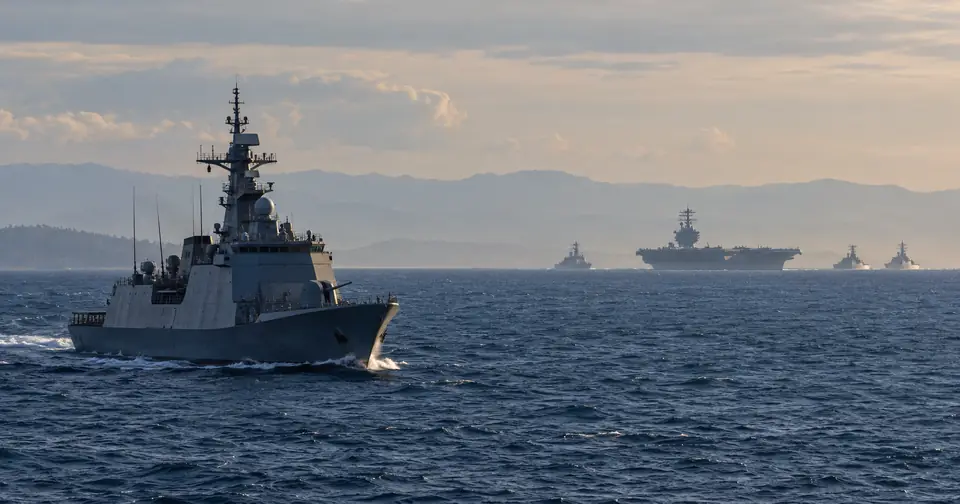
For residents, the practical takeaway is vigilance without panic. Any legal or diplomatic response depends on the carrier group's precise track and conduct, while defense authorities preserve the radar, radio and reconnaissance record.
What Western Mindanao Command disclosed
The Western Mindanao Command said in a statement on Monday, October 26, that its Maritime Situational Awareness Center and other maritime units tracked the People's Liberation Army Navy Liaoning Carrier Group as it transited the Zamboanga Peninsula on Thursday, October 22. The formation was first spotted northwest of Talulu Point in Siocon, Zamboanga del Norte, and later monitored southwest of Maitum, Sarangani, as it moved southeast toward the Celebes Sea, which the Philippines shares with Indonesia and Malaysia.
The command called the transit "continuous and expeditious" and estimated from the group's course and speed that it left the Western Mindanao area of operations around 11 p.m. on October 22. It said its units kept up coordination and reporting throughout, and it asked the public to stay calm and rely on official sources. The statement did not say whether the government would file a diplomatic protest.
The group consisted of the aircraft carrier Liaoning and three destroyers identified as Huainan, Wuxi and Anshan. Footage of the ships was also shared on social media by a resident who saw them pass.
Hour by hour down the western seaboard
Navy monitoring reports obtained by Bilyonaryo News Channel give the sequence. At 7:55 a.m. on October 22 the carrier group was about 15.2 nautical miles northwest of Talulu Point, heading south at 14 knots. The frigate BRP Diego Silang had been tracking the ships since they were spotted at around 7 a.m., and the patrol ship BRP Emilio Jacinto had already left port that morning to join.
At 10:03 a.m. the Naval Monitoring Station in Zamboanga picked up the formation on radar about 15.4 nautical miles southeast of the station as it passed through the Basilan Strait. The Chinese ships did not respond to radio challenges from Philippine authorities, and a source told the channel their Automatic Identification System, the transponder that broadcasts a ship's identity and position, had been switched off.
By 6 p.m. the group was about 54.8 nautical miles southwest of the monitoring station at Kalamansig, Sultan Kudarat, making 15.4 knots to the southeast, and the Coast Guard's BRP Sarangani joined Diego Silang in shadowing it. At 9 p.m. it was still being tracked southwest of the Maitum station. The Navy estimated an exit from its area by 11 p.m.
A later report at 5 a.m. on October 23 placed the formation about 25 nautical miles east southeast of Balut Island off Sarangani, Davao Occidental, moving northeast at 13.2 knots inside the area watched by naval forces on the eastern seaboard. By then three Philippine ships, Diego Silang, BRP Artemio Ricarte and Sarangani, were on it. The Philippine Air Force flew a Black Hawk helicopter and an NC212i light transport aircraft for reconnaissance during the transit.
How close, and why the number changed
Rear Admiral Roy Vincent Trinidad, the military's spokesperson for the West Philippine Sea, told reporters in a phone interview on Monday that the group came within about 50 nautical miles of the shoreline, closer than usual for either the Liaoning or the Shandong. "This time within 50 nautical miles nagpapakita sila, so nagpaparamdam sila," he said. At the Camp Aguinaldo briefing the next day he put the closest approach at 15 miles from the landmass, matching the Navy logs.
Trinidad said Chinese carrier groups normally pass the Philippines on the Pacific side, going north through the Bashi Channel or Balintang, down the eastern seaboard and sometimes as far as Australia before returning through the Sibutu Passage. This time the group took the western seaboard, which placed it inside the Sulu and Celebes seas. He linked the passage to Exercise Keen Sword, the large exercise under way in Japan with the United States and other partners, where the Philippines took part only as an observer.
He also said the silence on the radio should not be read as disrespect. The military challenges roughly 16,000 merchant and naval vessels passing Philippine waters each month and about 3,000 do not answer. "The aircraft carrier Liaoning did not respond to our challenge, they are not the only one who does not respond," he said, adding that the transit was a good test of how the Coast Guard, the Air Force and the Navy track a high value asset through the maritime domain.
Not the first time through the Basilan Strait
The same formation used the Basilan Strait in December 2025 on its way back to China, according to a Navy source cited by the channel, and the route will be watched in the coming months. Trinidad said at the Tuesday briefing that the passage was part of a periodic carrier training exercise the Chinese navy runs about twice a year. "It is no cause for alarm," he said. "Our maritime domain awareness is constant, active, and monitoring them."
Coast Guard spokesperson Rear Admiral Jay Tarriela said on the channel's On Point program that the deployment could be read as a show of force amid the recent exchanges between the Chinese Embassy in Manila and Philippine officials, but that Beijing would most likely call it innocent passage. He said there was no apparent reason for the carrier to zigzag along its route, and noted that American and European warships also use sea lanes through Philippine waters, among them the Sibutu Passage between the Sulu Archipelago and Borneo.
Barbers calls for a stronger presence
Ace Barbers, adviser and spokesman of the House prosecution panel and a former Surigao del Norte congressman, said on Monday the transit showed the need for stronger surveillance and response, including consideration of an appropriate site under the Enhanced Defense Cooperation Agreement. "This is not just a matter of Chinese warships passing through our waters. It is a matter of respect for the Philippines, our maritime authorities, and our sovereign rights," he said.
Barbers said foreign warships cannot invoke innocent passage as blanket cover for exercises, intelligence gathering or threatening maneuvers in the territorial sea, though whether this transit broke international law would depend on where the ships were and what they did. He urged the Navy, the Coast Guard, the defense department and the foreign affairs department to preserve radar and radio records, document the movements and pursue diplomatic action on verified facts.
Separately, Trinidad reported that the military counted 54 Chinese vessels in the West Philippine Sea from October 20 to 26, up from 31 the week before, a tally that does not include the carrier group. The count for October 13 to 19 placed seven Navy and seven Coast Guard ships at Ayungin Shoal, six and 11 at Bajo de Masinloc, five and two at Escoda Shoal, and four and 12 near Pag asa Islands.
Sources and verification
Reader response
- Views
- 9
- Shares
- 0
- Rating
- Not rated
- Comments
- 0