Earthquake recovery
Why Jose Abad Santos Students Still Have No Classrooms After the Mindanao Quakes
August 9, 2026 · Joshua S Bariñan
Two months after the June 8 magnitude 7.8 earthquake, schools in the remote Davao Occidental town of Jose Abad Santos are still wrecked. Repeated quakes and floods have flattened classrooms, pushed lessons under tents, and left nearly 900 high school students unable to go back to in person classes. The Department of Education is now hunting for new sites because the old campuses have no usable space left, while the mayor waits on a national budget for reconstruction.
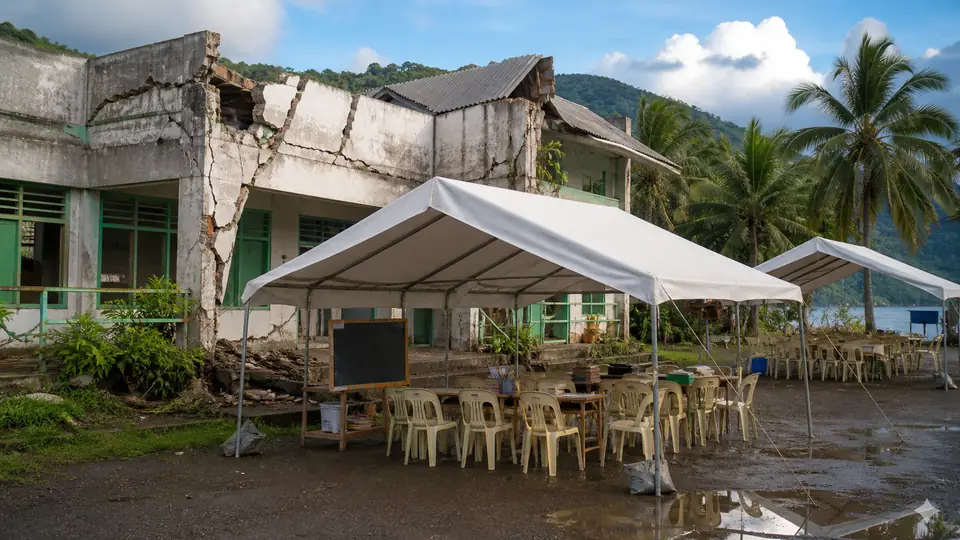
There is still no firm classroom return date for nearly 900 students. Tent capacity is limited, suitable replacement land has yet to be identified, and permanent rebuilding depends on national funding.
Which schools were damaged and how badly
Kalbay National High School in Barangay Kalbay took the heaviest blow. Every one of its buildings was already badly damaged in the June 8 quake, and the shaking on July 14 brought down the first floor of one building. Teachers and students there now hold classes under makeshift tents.
Three other campuses were hit hard. At Emeliano S. Fontanares Sr. National High School in Barangay Sugal, eight classrooms were totally destroyed, six suffered major damage, and two had minor damage, while the gymnasium and the concrete perimeter fence collapsed. Edna Guillermo Memorial National High School in Barangay Nuing lost 31 classrooms outright with three more heavily damaged. An extension campus of the regional agriculture and fisheries school in Barangay Caburan Big was also among the wrecked sites.
Mayor Jason John Joyce said the damage across these campuses is severe enough that ordinary repair is not an option for the worst of them.
Why students still cannot return
Nearly 900 high school students in the town remain unable to resume in person classes because their school is not safe to use. The tents and salvaged rooms cannot hold everyone, and the ground keeps moving.
Provincial Governor Franklin Bautista issued a memorandum order on August 1 declaring that in person classes would resume the following Monday, about eight weeks after the June quake and a little over three weeks after the floods. That plan was quickly upset. A magnitude 6.4 quake struck days later and forced officials to cancel classes again, underlining why families are wary of sending children back into cracked buildings.
Where DepEd plans to put the classrooms
The education department is looking for alternative locations because the existing school grounds are full or unsafe. "Hinahanapan pa ng space kasi wala na area sa compound nila," Joyce said, explaining that the central office had committed to provide learning continuity spaces but had not yet found the land for them.
Davao Occidental has been placed near the front of the line for those temporary structures. The plan calls for 77 learning continuity spaces across 23 sites in the province, spread among Jose Abad Santos, Don Marcelino, Malita, Santa Maria, and the town of Sarangani. In the meantime, the mayor said he is arranging makeshift classrooms while the town waits for money from the national budget to fund full reconstruction.
What funds and officials have moved so far
The department says it has released 3.51 million pesos for the immediate work on the ground. Of that, about 2.06 million pesos went to clean up and clearing operations and roughly 1.45 million pesos to minor repairs at damaged schools.
Education Secretary Sonny Angara went to the town to see the damage himself, joined by Cabinet Secretary Benjamin Abalos Jr. and Public Works Secretary Vince Dizon. They inspected the worst hit campuses to size up the repair bill and check on displaced students, teachers, and families, a visit meant to move the larger reconstruction budget along.
The string of disasters behind the damage
Jose Abad Santos has absorbed one blow after another this year. The June 8 magnitude 7.8 earthquake off southern Mindanao, centered near Maasim in Sarangani, started it, loosening slopes across the town. It was the strongest earthquake to strike the Philippines since 1976. Flash floods and landslides tied to the southwest monsoon and Typhoon Inday then swept through on July 10 and again around July 14, the same day a magnitude 6.5 quake struck the coast.
The aftershocks have not stopped, and the recent magnitude 6.4 event shows the sequence is still live. Each new tremor sets back a town that is hard to reach in the first place, connected to the provincial capital mainly by long mountain and coastal roads, which is part of why classrooms here are taking so long to come back.
Sources and verification
Reader response
- Views
- 4
- Shares
- 0
- Rating
- Not rated
- Comments
- 0