Education
Nearly half of Davao Region's Grade 1 to 3 pupils began the school year as struggling readers, and Davao City lost most of last year's gains over the break
October 28, 2026 · Joshua S Bariñan
The Second Congressional Commission on Education said on October 25 that 48 percent of Grade 1 to 3 learners assessed in Davao Region in June, and 45 percent in Davao City, were struggling readers at the start of school year 2026 to 2027. Davao City had cut its share of struggling readers from 45 percent to 9 percent by the end of the previous school year, so the new figure means most of that gain disappeared over the break. Schools division superintendent Reynante Solitario called the number a starting point for another year of intervention.
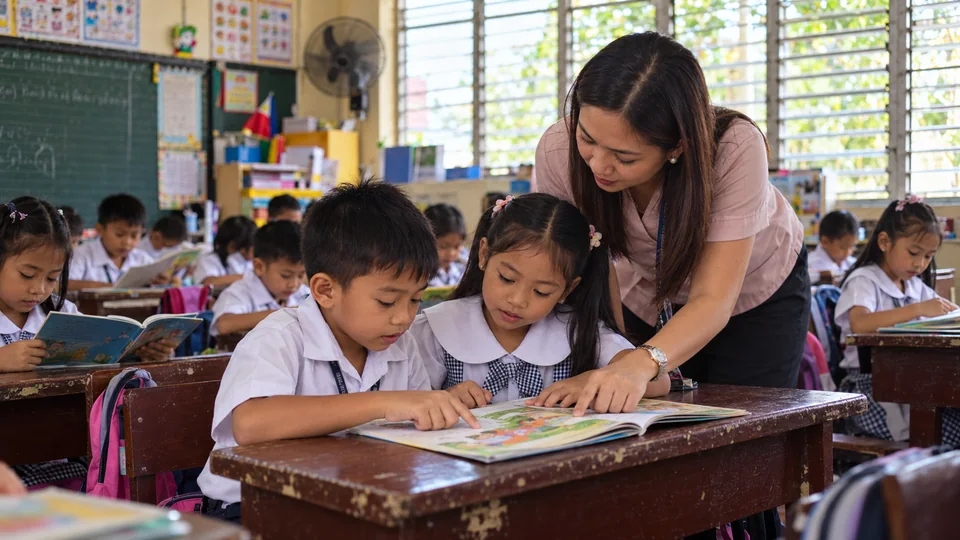
If your child is in Grades 1 to 3 in a Davao public school, ask the teacher for the child's CRLA reading profile. Pupils rated Low Emerging or High Emerging qualify for ARAL tutoring and school reading interventions, and the division's own data show those programs moved most pupils up at least two levels within a school year.
The June assessment
The figures come from the Department of Education's Comprehensive Rapid Literacy Assessment, or CRLA, given at the beginning of the school year in June. EDCOM 2 published them in an infographic on Facebook on Sunday, October 25 and on its website. Of 258,630 learners assessed in Region XI, 124,388 were at the two lowest of five levels, Low Emerging and High Emerging. Only 30,322, or 12 percent, were ready to read at grade level.
In Davao City, 83,559 pupils were assessed. 29,109 were Low Emerging and 9,119 High Emerging, together 38,228 or 45 percent. Another 22,319 were Transitioning and 12,040 Developing, and 10,972, or 13 percent, were Grade Level Ready. Mindanao Times rounded the city's share to 46 percent.
DepEd Memorandum 64, series of 2025, defines the levels. Low Emerging pupils know a few letters and their sounds and cannot blend them into simple words. High Emerging pupils recognize most letters but cannot decode words at their grade. Both groups need what the commission calls foundation support: systematic phonics and letter recognition. Developing pupils read some words and phrases but not continuously, and Transitioning pupils read with errors or slowly.
The national figure from the same assessment was about 45 percent, or 2,245,628 of 5,007,066 pupils assessed. The commission says the share of pupils reading at grade level falls as they move up: 30.52 percent in Grade 3, 19.56 percent in Grade 6, 0.74 percent in Grade 10 and 0.40 percent in Grade 12.
What happened over the summer
Davao City's number stands out because of what came before it. Solitario said in a Facebook post on Monday, October 26 that the division's struggling readers fell from about 39,750 at the start of school year 2025 to 2026 to 8,064 by the end, or from 45 percent to 9 percent. He credited the Academic Recovery and Accessible Learning program, known as ARAL, along with school reading programs, and said the division ranked third among the 11 schools divisions in Region XI with the lowest share of struggling readers.
The June assessment then put nearly half of the incoming group back at the bottom levels. Part of the difference is likely that the pupils are not the same children: a new Grade 1 intake arrives each June while the strongest Grade 3 readers move on. EDCOM 2 nonetheless framed the result as a question of whether gains made during the year survive the break, and SunStar Davao described it as an apparent setback.
"The 45% figure is not the end of our story. It is our starting point for another year of purposeful action, stronger collaboration, and renewed commitment," Solitario wrote in a separate post.
EDCOM 2 Executive Director Karol Mark Yee, speaking to local reporters in Davao City on Saturday, October 25, said the crisis built up over years of neglect and that teachers now see Grade 8 students who struggle to read a sentence and Grade 9 students who cannot read a paragraph. "The learning crisis did not happen overnight, it has compounded over the years. We must act now to address illiteracy, especially among children in Grades 1 to 3," he said in the commission's statement.
Where the problem concentrates
The commission also broke down the end of school year assessment from March 2026, counting only Grades 1 to 3. Davao Occidental had the highest share of struggling readers among the five provinces at 18.5 percent, or 3,471 pupils. Davao del Norte followed at 14.8 percent, or 8,502 pupils, then Davao Oriental at 13.4 percent with 4,522, Davao de Oro at 10.1 percent with 4,047 and Davao del Sur at 9.5 percent with 3,346.
At the town level, Talaingod in Davao del Norte had the highest share in the region at 49.6 percent, or 1,184 pupils. Talaingod is an upland town whose population is largely Ata Manobo, and its figure is more than twice that of any other town on the list. San Isidro and Kapalong, also in Davao del Norte, followed at 24.6 percent and 23 percent, though San Isidro's share represents only 32 pupils and Kapalong's 37. Don Marcelino in Davao Occidental was at 22.3 percent with 600 pupils, and Malita at 21.6 percent with 1,507.
The lowest shares were all in Davao de Oro: Mawab at 3.6 percent with 80 pupils, Compostela at 3.8 percent with 155 and Nabunturan at 5.9 percent with 247.
Senior high school reads better than the country, but not well
The commission paired the early grade data with the pilot Senior High School Literacy and Numeracy Assessment given to Grade 11 students at the end of school year 2025 to 2026. In Davao City, 25 percent of those assessed, or 8,453 students, were independent readers. Another 29 percent, or 10,097, were at the instructional level and 46 percent, or 15,914, were at the frustration level.
Across Region XI, 21 percent, or 18,181 students, were independent readers, 34 percent were instructional and 45 percent, or 39,171, were at frustration level. Nationally only 13 percent were independent readers and 58 percent were at frustration level. Region XI, Eastern Visayas and the National Capital Region were the only regions where half or fewer of Grade 11 students were at frustration level.
Solitario told Mindanao Times that a student at frustration level may struggle to understand texts without help, which affects mathematics, science and every other subject that depends on comprehension. He said the division will intensify literacy programs, target support to struggling readers and train teachers in evidence based reading strategies.
What the ARAL program is supposed to do
ARAL, created by Republic Act 12028 in October 2024, gives free tutoring in reading and mathematics to struggling pupils from kindergarten to Grade 10, using teachers, education students and volunteers as tutors. EDCOM 2 has credited it with early wins, but Rappler reported in May that DepEd was late in hiring tutors and that only a small share of the pupils identified for remediation were attending sessions.
The commission's argument for concentrating on Grades 1 to 3 is that a pupil who cannot decode words by the end of Grade 3 moves up without understanding lessons in any subject. The reading profile each child receives in June is meant to route that child to the matching support, from phonics drills for Emerging readers to more books for those already at grade level.
The next checkpoint is the end of school year assessment in March 2027. It will show whether Davao City repeats last year's drop, whether the gains hold through the next break, and whether Davao Occidental and Davao del Norte close the gap with the rest of the region.
Sources and verification
Reader response
- Views
- 1
- Shares
- 0
- Rating
- Not rated
- Comments
- 0