Infrastructure
Davao Region Lines Up 346 Billion Pesos for 2028 While the Samal Bridge, the Bypass and the Airport Wing Run on Thin 2026 Budgets
October 15, 2026 · Joshua S Bariñan
The Regional Development Council approved the Davao Region's Annual Investment Program for 2028 on September 10, and the figures were published this month: 4,568 programs and projects from 47 national agencies and state universities, with more than half of the money going to infrastructure. The plan lands while the region's flagship works are running on partial funding. The Samal bridge received a fraction of what its builders asked for this year, works on the government funded half of the city bypass stopped in January, and the airport terminal wing is under 40 percent built. Private investment has kept moving in the meantime, from a mall expansion to a delivery platform's first Mindanao office.
Davao City's share of the program is 57.21 billion pesos, second to Davao del Norte's 82.61 billion. The Department of Public Works and Highways accounts for 98.68 billion of the regional total, followed by the Department of Education and the Department of Transportation.
What the 2028 program contains
The council approved the program at its third quarter full council meeting. The total is 346.02 billion pesos. Infrastructure takes 190.58 billion, or 55 percent, social development 137.51 billion, or 40 percent, development administration 9.97 billion and economic development 7.77 billion. Projects that cover the whole region account for about 100 billion pesos across 856 entries. Among the provinces, Davao de Oro is programmed for 42.50 billion and Davao Oriental for 33.11 billion, while Davao del Sur gets 6 percent of the total and Davao Occidental 3 percent.
After the public works department, the biggest proponents are the Department of Education at 87.18 billion pesos, the Department of Transportation at 81.69 billion and the Department of Social Welfare and Development at 15.16 billion. The University of Southeastern Philippines leads the state universities at 8.02 billion. The remaining 43 agencies share the last fifth.
Named projects include an alternate road between Panabo City and Davao City, the Balut Island Port in Davao Occidental, the Linoan Small Reservoir Irrigation Project in Montevista, a regional training center for the National Police Commission, agricultural and fisheries border control facilities, sewage treatment at the Regional Government Center, regional public health laboratories, a rehabilitation center for girls in conflict with the law, foreshore mapping in 12 coastal barangays and two classroom school buildings in Davao Occidental.
A week earlier, on September 3, the council's infrastructure committee endorsed the infrastructure sector's 1,058 entries and a proposed Quimpo Flyover in Davao City with an indicative cost of 2.4 billion pesos, meant to sit over the existing six lane road and relieve the corridor.
The bridge and the bypass
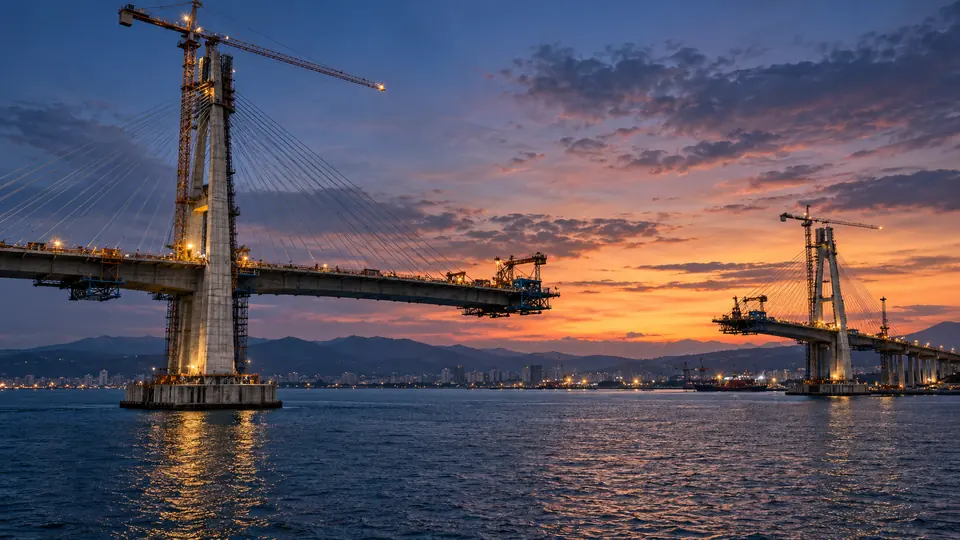
The Samal Island Davao City Connector was 61.334 percent complete as of June 25, slightly ahead of the 61.26 percent target for that date, DPWH Davao spokesperson Dean Ortiz said at the Habi at Kape forum on July 1. The office had asked the national government for 4.86 billion pesos for the project this year and received 314 million, and has requested supplemental funds. Ortiz dismissed social media videos suggesting the site had gone quiet, saying the crews were on break when the clips were shot. Work runs in two daytime shifts plus round the clock operations that let four sections advance at once, and the box girders are in, so the focus has moved to the superstructure. The target completion date is still September 2028, which he said could move because of the funding.
The Davao City Bypass Construction Project reached 49.26 percent as of December 31, 2025, according to the regional office of the Department of Economy, Planning and Development. Of its six contract packages, three are financed by a Japan International Cooperation Agency loan and three by the national budget. Package I-1, which holds the twin 2.3 kilometer tunnels and 7.9 kilometers of four lane road, stood at 65.89 percent. Package I-2 was at 7.45 percent and Package I-3 at 3.42 percent. On the government side, Package II-1 had reached 88.78 percent and Package II-2 80.75 percent, while Package II-3, which carries the road into Barangay J.P. Laurel in Panabo City, was scheduled for procurement this year. The full 45.5 kilometer bypass from Sirawan in Toril is meant to cut the Toril to Panabo trip from an hour and 44 minutes to 49 minutes and open in 2028.
In April the Regional Project Monitoring Committee reported that works under Package II had been suspended since January because the 2026 appropriation covered accomplishments only up to 2024, and that the JICA packages were held back by right of way problems in critical sections. The committee warned that a prolonged suspension could push completion to September 2030. Mindanao Live covered the tunnels, their builders and their opening target in September.
The Davao City Coastal Bypass Road, the 17.8 kilometer four lane road from Bago Aplaya to R. Castillo, is further along. Segment A, about 8 kilometers from Bago Aplaya to Times Beach, opened in July 2023, and Segment B, about 4.4 kilometers from Times Beach to Roxas Avenue, opened to motorists on December 19, 2025. DPWH said in May that Segment C, around 2 kilometers from Roxas Avenue to Sta. Ana Wharf, would open in June and cut the trip between Toril and parts of Poblacion from 45 minutes to about 15. Segment D, more than 3 kilometers from Sta. Ana Wharf to R. Castillo, is still under construction. The outlets Mindanao Live checked had not reported whether Segment C opened on schedule.
Airport, port and buses
The same committee inspected the region's transport projects on July 21 to 23 and approved its third quarter report on September 3. The expansion of the passenger terminal building at Davao International Airport was 38.17 percent complete. The Davao Public Transport Modernization Project, the bus system that is to replace jeepneys on the city's main routes, had an overall weighted accomplishment of 7.53 percent as of June 30. Davao Sasa Port continues to operate under the port terminal management framework following the turnover of operations to Globalport Davao Terminal, Inc.
The committee said the projects feed 55 infrastructure indicators that the council tracks, and that the regional plan for 2023 to 2028 still aims to make the Davao Region an international logistics center for Mindanao. The airport terminal and the bus project are the two to watch because both have public deadlines that their progress figures do not yet support.
Private money keeps moving
The city's investment promotion center says the macro numbers are still on its side. Davao City's economy grew 7.9 percent in 2024, with construction up 19.1 percent, transportation 12.6 percent and other services 10.8 percent, and the region grew 5.1 percent in 2025. Christian Cambaya, the center's head for investor assistance, told SunStar in September that the amended Investment Incentive Code now allows business tax exemptions of up to five years and real property tax relief depending on the project's classification, and that the center is pushing agribusiness, food processing, tourism, information technology services, manufacturing, health care, education, real estate, electric mobility and renewable energy.
The center's second Davao Global Connect, held at the SMX Convention Center in Lanang on Friday, September 18, brought delegates from the Philippines, Malaysia, Indonesia and Brunei for business matching under the Davao and Borneo growth corridor. The center said beforehand that the main output would be a Corridor Action Statement 2030 setting out where the two sides want to cooperate on infrastructure, trade and investment.
Two announcements this month show the private side at work. Lalamove opened its Davao operations at a press conference at Dusit Thani Davao on October 7, its first Mindanao market after ten years in Luzon and the Visayas. Managing director Djon Nacario said the company picked Davao after weighing its growth, digitalization and expanding industries, and will start with motorcycle, car, van and light truck deliveries before adding bigger vehicles. The company counts about 200,000 driver partners and serves about 10,000 businesses a day nationwide.
Ayala Malls, for its part, said in February that construction of a 2.5 billion peso expansion of Abreeza Mall would start in the first half of the year. The five storey building behind the mall adds three floors of retail and two of office space, about 15,000 square meters of leasable area, and is due in the second half of 2028. A facelift of the existing mall is budgeted at more than 1 billion pesos.
City Hall's own numbers
The city government expects its 2027 budget to come in around 16 billion pesos, finance committee chair Danilo Dayanghirang told the Pulong Pulong para sa Dabawenyos forum on October 13. About half would come from the national tax allotment and half from local taxes, and he said the city's income has grown by roughly 10 percent a year. The executive budget was due at the council by Friday, with first reading the following week, about three weeks of hearings and approval targeted for December.
Dayanghirang also addressed a dispute from September, when the Palace answered Representative Paolo Duterte's claim that the city had received no national funding since 2022 by publishing the figures: 52.80 billion pesos in national tax allotment to the city and its barangays from 2022 to 2026, of which 41.63 billion went to the city government and 11.17 billion to the barangays.
The items to watch over the next quarter are the supplemental release for the Samal bridge, whether Package II of the bypass resumes, the procurement of Package II-3, the next progress figure for the airport terminal, and the council's hearings on the 2027 budget, which will show how much of the city's own money goes into the Quimpo Flyover and the bus project.
Sources and verification
Reader response
- Views
- 2
- Shares
- 0
- Rating
- Not rated
- Comments
- 0