El Niño
Davao City Leans on Deep Wells, 24 Booster Pumps and a 200 Million Peso Disaster Fund as El Niño Heads for Its Peak
October 15, 2026 · Joshua S Bariñan
The Davao City Water District told reporters on Wednesday that it can lose half of its river supply before it has to ration, because 74 deep wells hold more than the city uses in a day. City Hall said the day before that it has over 200 million pesos in its disaster fund and that the mayor's disaster group has already met. Across the region, two thirds of local governments have started El Niño measures, and PAGASA now expects parts of the Davao Region to see almost no rain on most days from December to March.
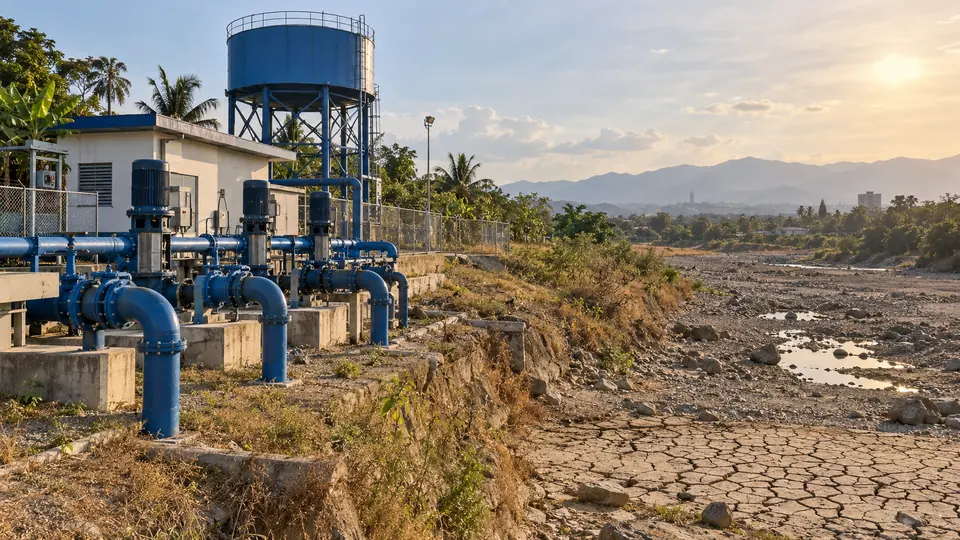
Davao City is preparing for a late-2026 water squeeze with reserve wells, pressure support, conservation measures and emergency funds. The planning window runs into early 2027, when the strongest effects of El Niño are expected.
What the water district said on Wednesday
Davao City Water District spokesperson Joanna Cresta Duhaylungsod briefed the Davao Peace and Security Press Corps at The Royal Mandaya Hotel on Wednesday, October 14. She said the utility had been tracking its sources since January, when PAGASA first flagged the chance of an El Niño forming by the end of 2026, and had started telling customers to expect a dry stretch. "We have already implemented preparation measures and started messaging our customers to anticipate the eventuality," she said.
The utility serves about 280,000 active connections with an average demand of 381,000 cubic meters a day. Against that it has roughly 688,000 cubic meters of daily capacity: 388,000 from 74 deep production wells and at least 300,000 in bulk surface water from Apo Agua Infrastructura, which draws on the Tamugan River. That leaves a buffer of about 307,000 cubic meters a day. Surface water is sent out first and the wells, which reach about 250 meters down, are held in reserve.
The arrangement has already been tested. Duhaylungsod said the Tamugan's flow fell about 70 percent at its lowest point in April and the utility has logged 77 separate episodes of reduced flow since January, with surface production dropping as low as 233,000 cubic meters. The wells covered the gap each time without pressure drops or interruptions. "That's the beauty of the conjunctive use," she said.
The trigger for emergency operations is a 50 percent fall in surface production, a cut of about 150,000 cubic meters a day. At that point the utility would ask households to limit use to essential needs, speed up repairs of leaking mains, and switch on the booster pumps it is now installing.
Twenty four booster pumps by December
The pumps go into 24 areas the utility calls hydraulically challenged, mostly elevated or rolling ground where pressure drops first: Langub, Catalunan Grande, Mamay in Barangay Belisario, Doña Salud, the old airport area and Vista Verde. Flat areas with narrow old mains, including parts of Agdao, are also on the list. Each site needs a certificate of no objection from the barangay, and power connections are being arranged with Davao Light and Power Company. Duhaylungsod said all 24 should be in place by December, before the dry season peaks.
Leak repair is the other half of the plan. At the press corps briefing in September she said the utility had commissioned satellite imaging to scan its entire pipeline network for underground leaks and had moved to a second pass to confirm that the leaks found in the first were fixed. "The result has been very rewarding because we have repaired many underground leaks," she said.
The utility is also running its Libreng Tubig promotion for three months instead of one. Under Board Resolution 26-173, residential customers with a half inch meter who use five cubic meters or less a month pay nothing for consumption in October, November and December, with the savings showing on bills issued from November through January. Customers still pay the 50 peso meter maintenance fee and any arrears. Duhaylungsod put the saving at close to 1,000 pesos per household.
City Hall's 200 million pesos
Councilor Danilo Dayanghirang, who chairs the city council's finance committee, told the Pulong Pulong para sa Dabawenyos forum on Tuesday, October 13 that the city does not need a new appropriation to respond. "We have enough budget on this under the disaster fund, and in fact, nag meeting na ang disaster group headed by Mayor Sebastian Duterte, and all the offices are already coming up with their own mitigating measures. So, we have enough funds for this, and we are ready," he said.
He said more than 200 million pesos is available under the disaster fund, that city offices are drawing up a list of the interventions they need, and that the Department of Science and Technology and PAGASA had briefed the city on the likely timing. The agencies told the city that typhoons would still enter the country for a while and that the real impact would come in January, February and March.
The statement came a week after agriculture committee chair Ralph Abella filed his resolution asking the mayor to convene a Task Force El Niño for farms and water, which Mindanao Live covered on October 9. Environment committee chair Temujin Ocampo had said on October 2 that his committee's monthly monitoring with the water district and Apo Agua showed no critical drop in the Panigan and Tamugan rivers feeding the Apo Agua weir. Committee records put average consumption in 2025 at 376 million liters a day against an approved Apo Agua capacity of 681 million liters, of which about 340 million is currently delivered.
Ocampo also warned against any proposal to send Davao water to neighboring towns during the dry spell. "Unahin natin sarili natin bago tayo mag supply sa ibang lugar," he said.
Two thirds of the region's local governments have started
Office of Civil Defense Davao Region director Ednar Dayanghirang told the Kapehan sa Dabaw forum at SM City Davao on Monday, October 12 that 67 percent of the region's 49 local government units had begun preparedness measures as of that day. The office's recommended sequence is to organize a task force, convene it, assess water, farm production and health at barangay level, and write a contingency plan from the findings. He pointed to Davao Oriental, which convened its provincial task force on October 9, as the model, and said a reported measure does not mean a finished plan or a secured water supply.
The Department of Agriculture's regional office has set aside 921 million pesos for its El Niño response, alternate disaster focal person Joedel Leliza told the Habi at Kape forum on September 16. That covers a 729 million peso action plan already being carried out, 66.3 million in ongoing procurement and 126 million requested from the national government. Within it, 40 million pesos goes to preparatory work and 9.9 million to saving production in the most exposed areas. Farmers on high risk land are being helped to shift to watermelon, soybeans and other crops that tolerate drought, and livestock raisers get veterinary drugs, biologics and feed against heat stress.
Damage is already on the books. The regional office counted 117 million pesos in losses from moisture stress between January and May, three quarters of it in rice and most of it in Matanao and Bansalan in Davao del Sur. By Wednesday the National Disaster Risk Reduction and Management Council put the Davao Region's agricultural damage at 410.1 million pesos, the third highest of ten affected regions and part of a national total near 6.5 billion pesos affecting 215,386 farmers and fisherfolk.
On the national side, Palace press officer Claire Castro said on October 1 that 6.2 billion pesos was earmarked for the Department of Agriculture this year for farmers and fishers hit by the weather, on top of a 39.83 billion peso disaster fund, and that Executive Order 53 had reactivated the national Task Force El Niño. On Wednesday Social Welfare Secretary Rex Gatchalian and Castro drank filtered water from a bucket kit at a briefing to show how stored rainwater can be made drinkable, after the President's advice to collect rain in buckets drew criticism. The OCD's Dayanghirang defended the advice, saying the President's years as a governor had taught him what local governments face.
What PAGASA expects
The weather bureau's Mindanao regional office released its climate assessment in the first week of October. By December most of Mindanao is projected to have 21 to 25 dry days a month, with the Davao Region, Soccsksargen and other parts of the south reaching the 26 to 31 band and staying there through February and March 2027. The September forecast put the odds of El Niño continuing above 90 percent through the February to April 2027 season, and the October 7 advisory said the event would peak before the end of this year.
August was a preview. Most Mindanao stations recorded between zero and 100 millimeters of rain against a normal range of 101 to 300. The bureau issued 175 thunderstorm advisories and one rainfall advisory for the month and no heavy rainfall warnings. Hinatuan in Surigao del Sur hit 37.5 degrees Celsius on August 9, beating its previous ten year record of 37.2 set in August 2016. The bureau noted that cyclones passing north of Luzon pull the monsoon with them and leave Mindanao dry rather than wet.
The checkpoints for the next few months are the water district's 50 percent trigger on surface production, whether the 24 boosters are running by December, and the list of interventions the city's offices hand to the disaster fund. The water district's bulletins will say when the first of those is reached.
Sources and verification
Reader response
- Views
- 1
- Shares
- 0
- Rating
- Not rated
- Comments
- 0