Davao technology
Davao City Eyes AI Robots for Public Service After Council Demo
June 3, 2026 · Joshua S Bariñan
Davao City officials are studying whether humanoid AI robots can help with queues, public information, disaster response, and routine city hall services after a live City Council demo.
Key Takeaways
- The proposal is framed as support for public service workers, not a direct replacement for them.
- Any rollout still needs committee review, budget approval, procurement, testing, and safeguards.
Two humanoid robots reached the council floor
Davao City is testing a big civic technology idea: whether humanoid AI robots can help modernize public service delivery and reduce routine work inside local government offices.
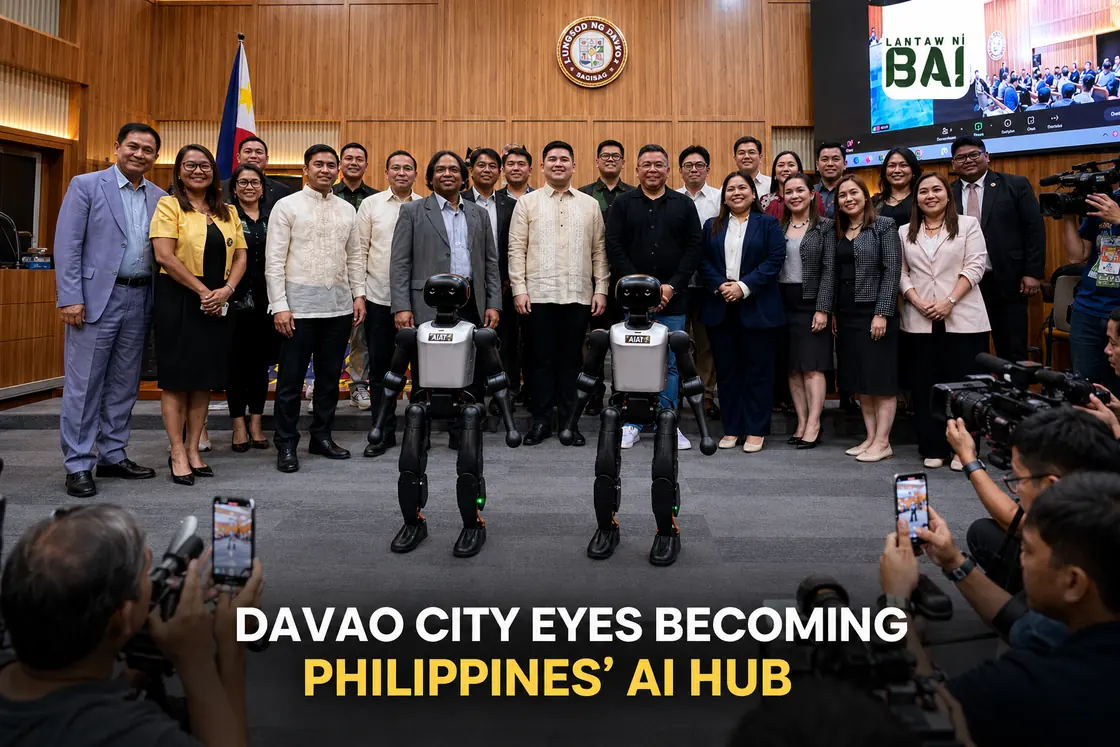
The proposal became more concrete on June 2, 2026, when representatives from East West International Education Specialist Inc. brought two three foot humanoid robots to the Sangguniang Panlungsod during a regular City Council session.
EWIES President and CEO Dennis Franco M. Layug, together with partner Jeffrey Peter, demonstrated the robots before councilors. Officials were able to ask the machines questions directly and see how they responded in real time.
The demo mixed showmanship with practical features
The robots first got attention in a lighter way: the two units danced to Michael Jackson’s Billie Jean before the more serious part of the presentation. It was a crowd puller, but the pitch went beyond entertainment.
According to EWIES, the robots can translate up to 200 languages and answer a wide range of questions. That matters for a city government setting where residents often need directions, forms, office guidance, or basic information before speaking with a staff member.
For Davao City, the practical question is not whether a robot can impress a room. It is whether the technology can make long queues shorter, routine questions faster, and frontline offices easier to navigate.
Councilors framed it as support, not replacement
The demonstration was introduced through a privilege speech by Councilor Bonz Andre Militar, chair of the City Council’s Committee on Information Technology. Militar framed the presentation as part of the city’s wider effort to explore emerging technologies with real use in local governance.
He also addressed the concern many residents and public workers may have: the robots are not being pitched as replacements for government employees. The goal is to reduce repetitive work such as queues, paperwork, and routine administrative questions.
If the idea works, city personnel could spend more time on responsibilities that require judgment, empathy, coordination, and accountability, while machines handle the first layer of repetitive information work.
Where the robots might be used
If the plan moves forward, Davao City hopes to begin using the AI robots as early as next year. Possible use cases being discussed include public safety, disaster response coordination, and frontline information services in government offices.
Those are very different jobs, so the city still has to be careful. A robot that answers office questions is not the same as a system used during emergencies. Public safety and disaster response would require stronger rules, human supervision, testing, and clear accountability.
The safest early use may be the simplest one: helping residents at city hall counters find the right office, understand common requirements, and avoid waiting in the wrong line.
The plan still needs hearings and budget review
Nothing is final yet. City officials acknowledged that the proposal still needs to pass through committee hearings and budget allocation before any deployment can happen.
That means the demonstration is a serious signal, but not a purchase order. The project still has to survive procurement rules, budget questions, maintenance planning, data privacy concerns, and the everyday test of whether residents actually find the service useful.
EWIES already works in AI, robotics, and digital learning programs for schools across the Philippines, so the idea is not coming out of nowhere. The question now is whether an education technology footprint can translate into dependable local government service.
Why this matters for Davao
Davao City has been positioning itself as a digital transformation hub in Mindanao. The robot demo fits that broader direction: local leaders want the city to be seen as a place that studies new technology early rather than waiting until it becomes ordinary elsewhere.
That ambition should be balanced with practical judgment. Residents do not need technology for its own sake. They need city services that are faster, clearer, fairer, and easier to use.
For now, the vision is on the table. Davao residents can expect more deliberation before any robot appears at a city hall counter, but the city is clearly serious about exploring how AI and robotics might fit into public service.
Frequently Asked Questions
What risks should the city review?
The city should review privacy, procurement cost, maintenance, human supervision, disaster response reliability, and who is accountable when automated advice is wrong.
Sources and verification
Reader response
- Views
- 4
- Shares
- 0
- Rating
- Not rated
- Comments
- 0